



Contents: Installation ↡ M112/113 ↡
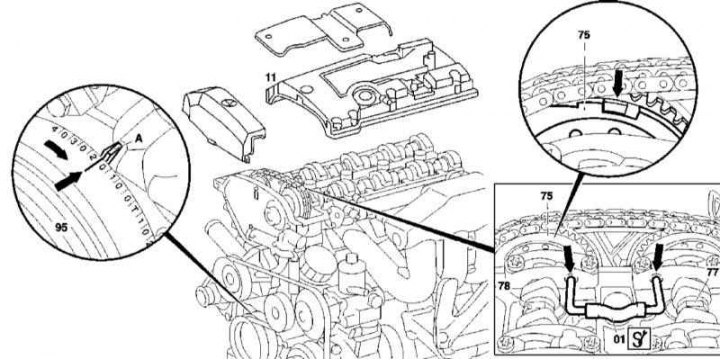
Checking the basic position of the camshafts of the 111 series engine
1. Illustrative material for checking the basic position of the camshafts of the 111 series engine is presented in the illustration, to which all references in the text refer.
2. Remove the cylinder head cover (11).
3. Turning the crankshaft in the normal direction, bring the piston of the first cylinder to the position 20° after TDC, - the 20° mark of the measuring scale on the torsional vibration damper (95) should be aligned with the pointer (A) on the timing drive cover, and the cams of the drive of the intake (78) and exhaust (77) valves of the first cylinder should turn with their working projections upward at an angle.
4. Check the freedom of passage of the locking rod (01) in the holes of the bearing cap No.1 or No.6 and the locking holes of the intake or exhaust camshaft.
5. Due to the tension of the timing chain, the intake camshaft should be positioned between 20 and 30 degrees, and the exhaust camshaft between 25 and 35 degrees after TDC.
Note: A 1 tooth offset in chain seating results in a 20 degree shift, adjust as necessary (see below).
6. When the basic installation is correct, the stop on the sprocket (75) of the intake camshaft should be shifted towards the "lag", i.e. be shifted in the flange recess in the direction of rotation of the camshaft (arrow).
7. Reinstall the removed components in the reverse order of removal.
Installation
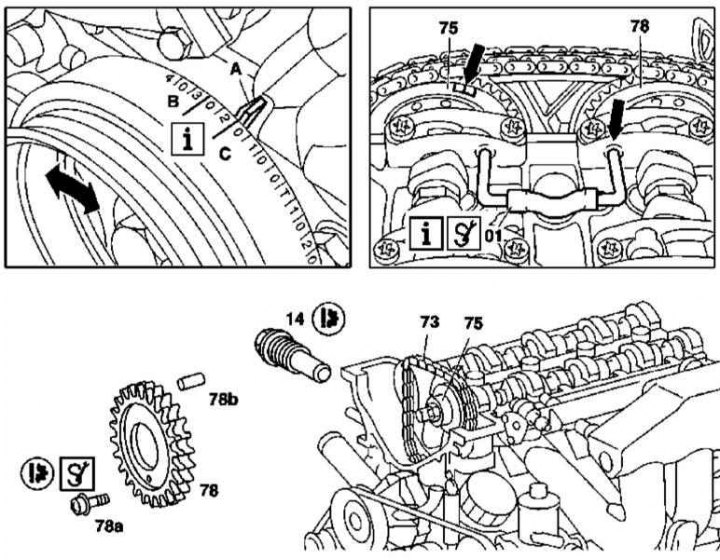
Setting the base position of the camshafts of the 111 series engine
1. Illustrative material on adjusting the base position of the camshafts of the 111 series engine is presented in the illustration, to which all references in the text refer.
2. Check the basic setting of the camshafts (see above).
3. Remove the front cylinder head cover (see Section Removal and installation timing belt covers).
4. Turn the crankshaft in the normal direction, bring the piston of the first cylinder to the position 30° after TDC - in this position of the engine, the camshafts can turn without the risk of collision of the valves with the pistons.
5. Remove the chain tensioner (14) (see Section Removal and installation of timing drive components).
6. Remove the exhaust camshaft sprocket (78).
7. Pull up and remove the timing chain (73) from the intake camshaft sprocket (75).
8. Turn the camshafts to the base position and secure them with locking pins (01) inserted through the holes in bearing caps Nos. 1 and 6.
9. Pull the chain up and return the piston of the first cylinder to the 20° after TDC position.
10. Place the chain (73) on the sprocket (75) of the intake camshaft, after making sure that the latter is in the correct position.
11. After threading the chain, install the sprocket (78) of the exhaust shaft into place.
12. Install the chain tensioner (14) (see Section Removal and installation of timing drive components).
13. Remove the locking rods (01).
14. Make sure the basic settings are correct (see above).
M112/113
Checking and installation
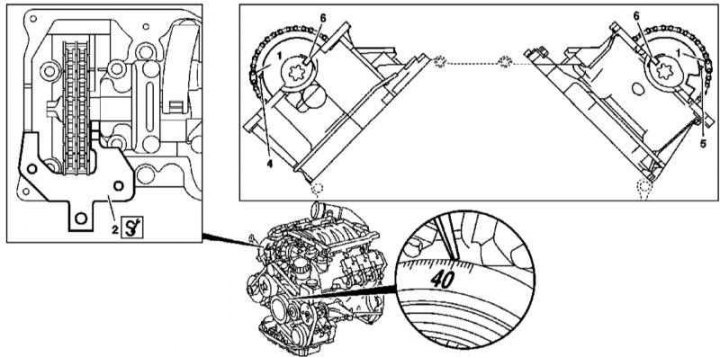
Setting the base position of the camshafts of the 112 and 113 series engines
1. Illustrative material on adjusting the base position of the camshafts of series 112 and 113 engines is presented in the illustration, to which all references in the text refer.
2. Remove the cylinder head covers.
3. Check the correctness of the basic position of the camshafts - if necessary, rotate the engine to the position 40° after TDC of the piston of the first cylinder.
[Text republished from the website MercedesMan.ru]
4. Remove the chain tensioner (see Section Removal and installation of timing drive components).
5. Remove the Hall sensor.
6. After lifting the chain, remove the sprocket first from the right, then from the left camshaft.
7. Using an open-end wrench, rotate the left camshaft to its base position - the grooves (6) rotated toward the engine's centerline should align with the joint line of the covers with the heads - and secure it with the locking plate (2), placing the latter flush with the left head and inserting it into the groove (6) of the camshaft.
Note: At the position of the piston of the first cylinder 40° after TDC, the camshaft can turn without the risk of piston collision with the valves.
8. Proceed in a similar manner to align the right camshaft.
9. When threading the chain, install the camshaft sprockets in place (first left, then right).
10. Install the Hall sensor.
11. Install the chain tensioner (see Section Removal and installation of timing drive components).
12. Make sure that the timing marks are aligned correctly, then install the cylinder head covers.