



Contents: Car interior ↡ Wheels and brakes ↡ The bottom of the car ↡ Engine compartment ↡ Body ↡ Luggage compartment ↡ Additional works ↡ Engine compartment hood ↡ Opening ↡ Closing ↡
The suggested recommendations assume that the vehicle maintenance procedures are performed by the vehicle owner himself, as opposed to work performed at a service station of a representative branch of the Mercedes-Benz company. Although this schedule is based on the manufacturer's recommendations, the intervals between most procedures can be shortened at the owner's discretion, for example, checking and changing lubricants and fluids should be performed at intervals that ensure maximum service life of the engine or drive. In addition, if the owner is interested in maintaining the vehicle in a state of maximum readiness for use in case of possible resale, many procedures can be performed more frequently. We only welcome such an initiative.
Initial servicing and inspection of a new vehicle must be performed at a representative service station of the company in order to fulfill the terms of the warranty obligation. Such inspection is free of charge.
List A: The procedure is performed if the mileage since the last service according to List B is less than 22,000 km.
List B: The procedure is performed if the mileage since the last service according to List B is more than 22,000 km.
As part of the technical maintenance, it is also necessary to carry out additional activities marked with the C sign. They are carried out when a specified mileage has been covered or a specified time has elapsed since the last activity marked with the C sign.
Primary maintenance is performed according to list B.
Car interior
Check the proper functioning of the following devices:
- A and B Sound and light signals, hazard warning lights and direction indicators;
- A and B Indicator lamps, illumination and interior lighting;
- A and B Outdoor Lighting Fixtures;
- A and B Windscreen Wipers;
- A and B Windscreen Washers (including headlight washers).
- A and B Check the serviceability and condition of the seat belts.
A and B Reset the FSS indicator on the instrument cluster (Section Scheduled Maintenance Due Date Indicator (ASSYST)).
Replace the air filter of the heating and ventilation system.
Wheels and brakes
A and B Adjust tire inflation pressure.
Check the proper functioning of the parking brake and the reliability of its holding the vehicle on a slope.
Check the condition of the tyres and measure the remaining tread depth.
Remove the wheels and check the remaining thickness of the brake shoe friction linings.
Evaluate the condition of the brake discs.
B Replace/rotate wheels (all four wheels must be the same size).
The bottom of the car
Inspect the underbody components of the engine, transmission and exhaust system for fluid and gas leaks and damage.
Inspect the condition and correct routing of hydraulic and fuel lines. Look for cracking, crushing, and chafing.
Check the condition of the ball joints and their boots, as well as the silent blocks.
Assess the degree of wear of the steering gear components (play) and check the condition of the protective covers.
Engine compartment
Check the components in the engine compartment for signs of leaks.
Check the condition and correct routing of hydraulic and fuel lines.
A and B Replace the engine oil and oil filter.
Check the levels of all working fluids:
- A and B Cooling Systems;
- A and B Brake system;
- A and B Windscreen Washers;
- In Power steering systems;
In Body clearance adjustment systems.
B Check the condition of the drive belts.
B Replace the dust filter.
A and B Check the electrolyte level in the battery (except for unattended).
A and B Check the operation of the hood lock latch.
Body
Check that the headlight optical axes are adjusted correctly and make the appropriate adjustments if necessary.
In Replace the working elements of the windshield wipers (including headlight washers).
Luggage compartment
A Check and adjust the spare tire inflation pressure.
A and B Check the expiration date and, if necessary, replace "TIREFIT" tire sealant (if any).
Additional works
Once at the first maintenance
A and B Adjust the parking brake equalizer.
Every 30,000 km or 2 years
Check the functionality and lubrication, if necessary clean the towing device with a removable head and automatic lock.
Every 50,000 km or 2 years
C Replace the charcoal canister of the fuel vapor recovery system.
Every 2 years (in spring if possible)
C Replace the brake fluid.
C Check the condition of the body paintwork.
C Check the chassis and body parts for damage and corrosion.
Every 3 years after the last inspection
C Clean the guides and pads of the sunroof sliding panel:.
C Clean and lubricate the guide elements of the panoramic sliding roof panel.
Every 60,000 km or 4 years
For Diesel Engines: Replace the fuel filter.
From 60,000 to 90,000 km or 4 years
C Engine 271: Replace spark plugs.
Every 80,000 km
C Check the condition of the flanges and the flexible coupling of the cardan shaft.
C Engine 612.990: Replace air mass meter.
From 90,000 to 110,000 km or 4 years
For Engines 111, 112: Replace spark plugs.
Every 100,000 km or 4 years
C Engine 271: Replace air cleaner element.
Every 120,000 km or 4 years
For petrol engines 111, 112, 271: Replace the fuel filter.
With Diesel Engines with Air Cleaner Service Indicator: Replace the air cleaner element and reset the service indicator (Section Scheduled Maintenance Due Date Indicator (ASSYST)).
Every 250,000 km or 15 years after the last replacement
Original published on the website (MercedesMAN.ru)
C Replace the coolant.
Engine compartment hood
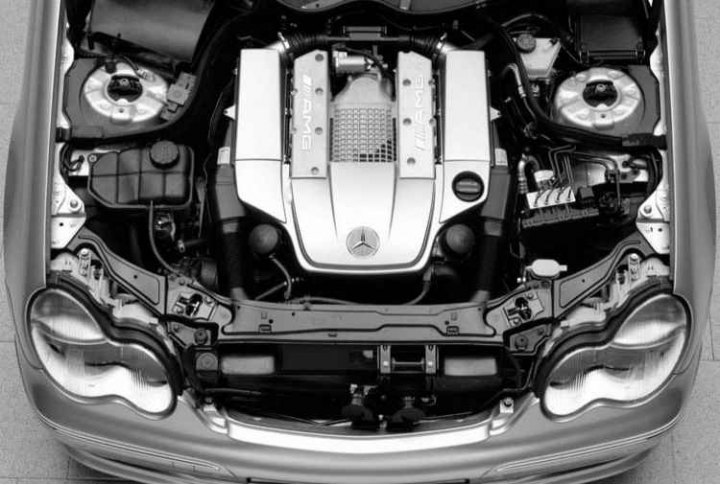
View under the hood. Petrol engine 3.2AMG
View under the hood. 4-cylinder petrol engine
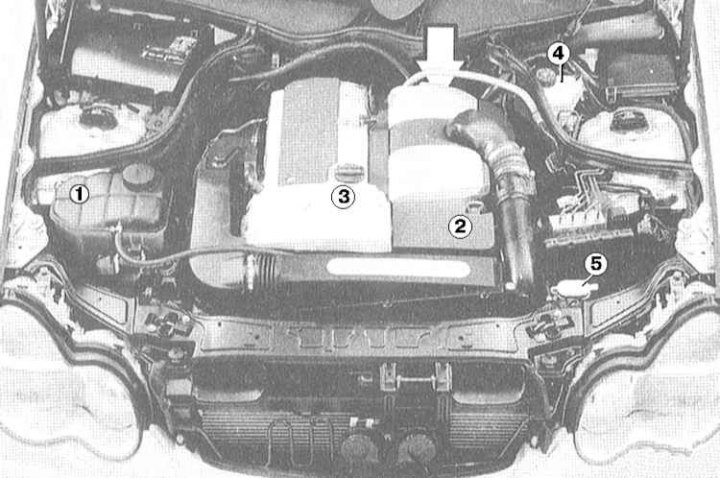
1 — Extended coolant reservoir
2 - Oil level dipstick
3 — Oil filler cap
4 — Brake fluid reservoir
5 — Windscreen washer fluid reservoir
There is a risk of injury!
There is a risk of injury when the hood is open and the engine is running.
After the engine is turned off, the radiator fan blades may rotate for approximately 30 seconds.
The engine is equipped with an electronic ignition system. Due to the high voltage of the ignition system, it is very dangerous to touch the ignition system components (ignition coil, ignition distributor, high tension wire, spark plug tips, test connector):
- With the engine running,
- When starting the engine,
- When the key in the ignition switch is in position 2 and the engine crankshaft is turned by hand.
Opening
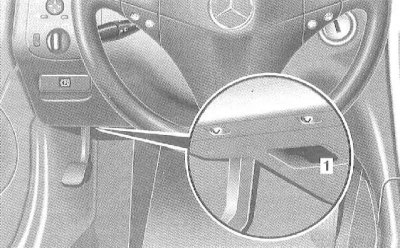
1. Pull the lever in the direction of the arrow - the hood is released.
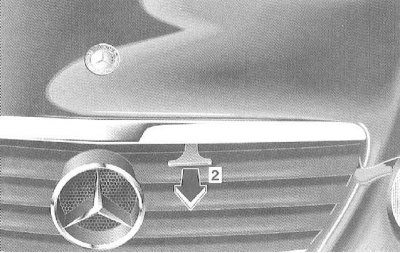
2. Pull handle "2" out of the radiator grille and open the hood - do not lift it by the handle.
Make sure that the windshield wiper arms are not in the folded position.
Closing
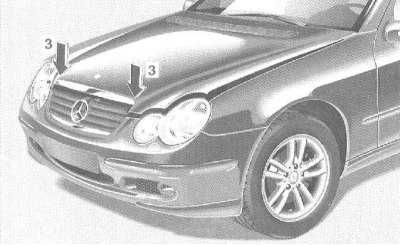
1. Close the hood. While doing this, hold on to the edges "3" with your hands only.
2. If the hood does not lock, open it again and slam it shut with more force.