
Cars BMW Cars Volkswagen Cars Chevrolet Cars Land Rover Cars Lada Cars Honda Cars Peugeot
English Русский
Български
Беларускі
Український
Српски
Hrvatski
Română
Polski
Slovenský
Magyar
Bookmark News and articles Sitemap Feedback Site search
MercedesMan.ru


A-Class C-Class E-Class G-Class M-Class S-Class Others
190 (W201) (1982-1993) W202 (1993-2000) W203 (2000-2007)
  • Main
  • C-Class
  • W202 (1993-2000)
  • General information
  • Driving a car
  • Cruise control

Cruise control (Mercedes-Benz C-Class W202)

0
Cruise control


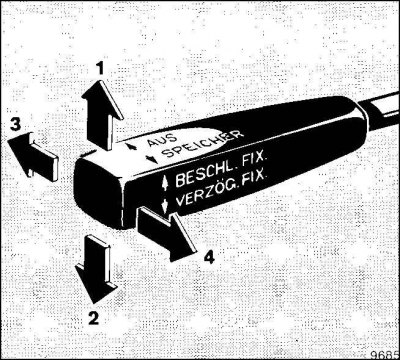
It can be used to maintain any speed exceeding 40 km/h, including the switch.

1. Fixation (touch the switch).

Acceleration (hold the switch).

1. Fixation (touch the switch).

Slowing down (hold the switch).

In normal mode, the car accelerates to a significant speed with the accelerator pedal. Short touches to position 1 or 2 will maintain this speed and the accelerator pedal can be released.

If you need to increase the speed, for example, to overtake, use the accelerator pedal. If you release the pedal again, the previously selected speed is automatically set again.

If the recorded speed needs to be increased or decreased slightly (for example, to pass a traffic light), hold the switch in position 1 or 2 until the desired speed is reached. If the switch is released again, the new speed will be fixed.

By briefly touching the switch in position 1 or 2, the speed will increase or decrease by 1 km/h.

To turn off cruise control, move the switch briefly to position 3. Cruise control is also turned off when the brake pedal is used or the speed decreases to less than 40 km/h (for example, in the mountains).


Memory


If the switch is moved to position 4 at a speed greater than 40 km/h, the speed set before switching off will be restored.

If the ignition key is turned to 1 or O, the last stored speed value will be erased.

Example: If the engine braking action is not sufficient when driving downhill, the entered speed will be exceeded and it will be necessary to brake if necessary. If the brake was not used, then as soon as the slope ends, the previously entered speed will be set again.

Memory must be used when you are absolutely sure of the speed you have memorized. To avoid overspeeding the engine, do not set it to N when driving with cruise control.
This article is available at: russian, bulgarian, belarusian, ukrainian, serbian, croatian, romanian, polish, slovak, hungarian
The article has been verified: Khromov Roman Mikhailovich
Share with friends:
◀ Previous
C-Class W202 / Driving a car
Next ▶

Vehicle motion control
Driving mode selection switch
Installing the gear selector lever
Starting off and changing gears
Parking brake
Oil and fuel consumption
Starting the engine from an auxiliary battery
Towing a car
Jacking and lifting the car
More similar articles for repairing other models

☛ Tempomat (cruise control) Mercedes W168 (1997-2004)
☛ Cruise control system Mercedes W124 (1984-1995)
☛ Instrument cluster, gauges, control lamps and indicator lights Mercedes W463 (1999-2019)
☛ Tempostat or cruise control (ML 430) Mercedes W163 (1997-2005)
☛ Remote control and special functions Mercedes W140 (1991-1998)
☛ Cruise control systems TEMPOMAT and SPEEDTRONIC Mercedes Vito 2 (2003-2014, diesel)
Link in different formats to this article
Comments and feedback from visitors
No comments yet


How much will 34 + 33 ?


W203 (2000-2007) 
  • General information
  • Introduction to guide
  • User manual
  • Maintenance
  • Power unit
  • Gasoline engines
  • Diesel engines
  • Cooling system
  • Ventilation and heating
  • Supply system
  • Injection system (gasoline)
  • Injection system (diesel)
  • Exhaust system
  • Ignition and control system
  • Charge and launch systems
  • Transmission
  • Mechanical gearbox
  • Automatic gearbox
  • Clutch and drive shafts
  • Differential
  • Chassis
  • Brake system
  • Car suspension
  • Steering
  • Body
  • Exterior (external elements)
  • Interior (internal elements)
  • Electrical equipment
  • Equipment and devices
  • Lighting system
  • Electrical diagrams (2000)
  • Electrical diagrams (since 2001)
W202 (1993-2000) 
  • General information
  • User manual
  • Driving a car
  • Car care
  • Maintenance
  • Power unit
  • Gasoline engines
  • Diesel engines
  • Lubrication system
  • Cooling system
  • Heating and ventilation
  • Ignition system
  • Fuel system
  • Injection system (gasoline)
  • Injection system (diesel)
  • Exhaust system
  • Transmission
  • Clutch
  • Car gearbox
  • Chassis
  • Suspension, wheels and tires
  • Steering
  • Brake system
  • Body
  • Exterior (external elements)
  • Interior (internal elements)
  • Doors and windows
  • Electrical equipment
  • Equipment and devices
  • Power devices
  • Lighting system
  • Electrical circuits
190 (W201) (1982-1993) 
  • General information
  • Introduction to the guide
  • Operation and care
  • Maintenance (gasoline)
  • Maintenance (diesel)
  • Troubleshooting
  • Power unit
  • Petrol engine I4
  • Petrol engine V6
  • Diesel engines
  • Engine overhaul
  • Cooling and heating
  • Power system (carburetor)
  • Injection system (gasoline)
  • Injection system (diesel)
  • Exhaust system
  • Charge and start system
  • Ignition system (I4)
  • Ignition system (V6)
  • Diesel heating system
  • Transmission
  • Clutch
  • Mechanical gearbox
  • Automatic gearbox
  • Cardan shaft and axle shafts
  • Chassis
  • Brake system
  • Car suspension
  • Steering
  • Body
  • Exterior (external elements)
  • Interior (internal elements)
  • Doors, locks and windows
  • Electrical equipment
  • Equipment and devices
  • Electrical circuits
 
MercedesMan.ru © 2017–2026 · Mobile version · Read about Mercedes · Sitemap: EN BG BY UA RS HR RO PL SK HU · Feedback · Site search · Bookmark A-Class (W168) · C-Class (W201) · C-Class (W202) · C-Class (W203) · E-Class (W123) · E-Class (W124) · E-Class (W210) · G-Class (W463) · M-Class (W163) · S-Class (W116, petrol) · S-Class (W126, petrol) · S-Class (W140) · S-Class (W220) · Sprinter · Vito 1 · Vito 2 · Vario 814D ·
 
We only use cookies without which some of the site's features may not be available.