



Contents: Examination ↡ Checking the safety valve ↡
Cooling System Pressure Testing Tools
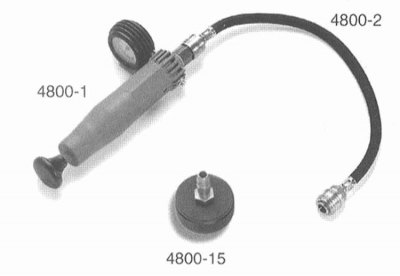
4800-1 - Hand pump
4800-2 — Hose
4800-15 — Nozzle
Examination
Leaks in the cooling system and the function of the safety valve in the cap can be checked using a commercially available measuring device. The following HAZET tools are suitable for this: hand pump 4800-1 with hose 4800-2 and nozzle 4800-15.
Caution! If the cylinder head gasket has been replaced, warm up the engine to operating temperature and let it cool before checking. This ensures the tightness of the cylinder head gasket.
When the engine is hot, cover the expansion tank with a thick cloth before opening it to prevent burns from hot coolant and steam. The cap should only be removed when the coolant temperature is below + 90°C.
1. Turn the cap on the expansion tank ½ turn to the left and release the pressure in the cooling system. Then turn the cap further and remove it completely.
2. Set the heater switch in the passenger compartment to maximum power.
3. Check the coolant level, top up if necessary, refer to the relevant section.
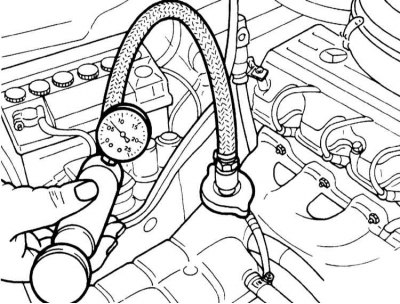
4. Install the testing device on the fluid filling nipple. Use the device's pump to create a pressure of approximately 1.4 atm. If the pressure drops, locate the leak and eliminate the leak.
Note: The illustration is for informational purposes only and may not fully correspond to the model in question.
5. If the pressure drops and there is no fluid leak, the cause may be internal leaks, such as damage to the cylinder head gasket or a crack in the housing.
Checking the safety valve
The safety valve is located in the expansion tank cap. Its task is to open the cooling system and drain the liquid when a certain pressure is reached.
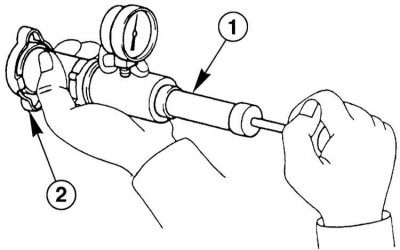
1. Screw the cover (2) onto the control device (1).
Note: The illustration is for informational purposes only and may not fully correspond to the model in question.
2. Create the required pressure as specified in the Specifications. The relief valve opens in two stages. The vacuum valve opens when a vacuum is created.
Note: The valve opening pressure is indicated on the cover in atm x 100. If, for example, the cover says "140/200", we are talking about a two-stage cover and the valve opening pressure is 1.4 and 2.0 atm.