



Contents: Examination ↡ Installation ↡
The temperature sensor measures the coolant temperature and transmits the corresponding signals to the control device. The sensor contains an NTC element (NTC – negative temperature coefficient), which decreases its resistance as the temperature increases. If the sensor is faulty, the control device outputs a reserve value. This leads to the fact that the duration of the preliminary and subsequent heating is not maintained correctly.
1. 2.0L Engine: Remove the 6-pin plug from the heat control relay and measure the resistance between pin 6 on the plug and the housing (engine cylinder block). If the resistance tends to infinity, there is a break in the current-carrying line. If the resistance is below 1 Ohm, there is a short circuit in the electric line.
Specified value:
- at 25°C: 2442 Ohm + 170 Ohm
- at 80°C: 291 Ohm + 16 Ohm
2. 2.2/2.5L engine: Reduce the coolant pressure by removing the cap from the expansion tank filled with coolant.
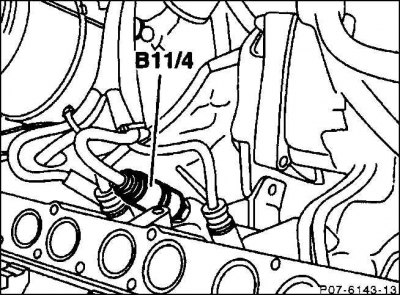
3. Disconnect the plug (B 11/4) and unscrew the coolant temperature sensor.
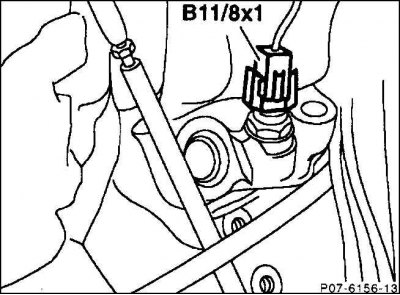
4. Disconnect the plug (B 11/8x1) and unscrew the "coolant temperature sensor for subsequent heating" on the cylinder head.
Examination
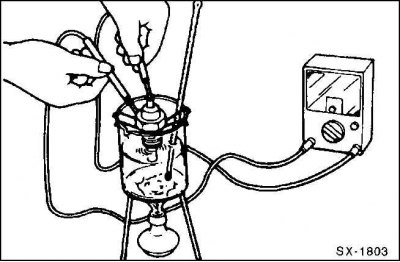
1. Hang the thermometer in a water bath and heat it slowly.
2. Check the resistance of the temperature sensor with an ohmmeter. The measured value is OK if it is within the tolerance of + 5% (see table Temperature sensor resistance).
3. If the temperature sensor does not reach the specified values during measurements, it should be replaced.
Installation
1. Screw in the temperature sensor with a torque of 20 Nm.
2. Insert the cable plug (connector).
3. Fill with coolant.
4. Warm up the engine and check the coolant level.
Temperature sensor resistance
| Temperature | Resistance |
| 20°C | 2500 Ohm |
| 30°C | 1700 Ohm |
| 40°C | 1170 Ohm |
| 50°C | 830 Ohm |
| 60°C | 600 Ohm |
| 70°C | 435 Ohm |
| 80°C | 325 Ohm |
| 90°C | 245 Ohm |
| 100°C | 185 Ohm |