



General information
The torque developed by the engine is transmitted through the automatic transmission to the transfer case equipped with an interaxle differential and from there, via cardan shafts, to the differentials of the front and rear axle assemblies.
All models considered in this Manual have a non-disconnectable all-wheel drive. The design of the two-stage transfer case includes a mechanism for locking the interaxle differential. The transfer case gearbox is fully synchronized, so that gear shifting can be done while driving. There are also mechanisms for forced locking of both interaxle differentials.
Differential locking procedure
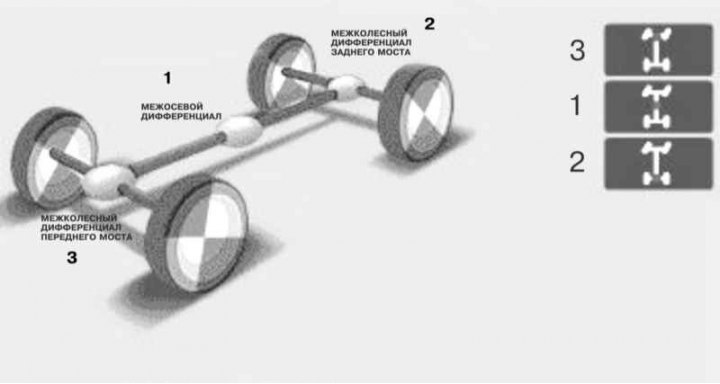
The differential lock is controlled by switches mounted in the central part of the vehicle's instrument panel (see Section Interior controls and equipment). The locking must be performed strictly in a specific sequence: INTERCENTER DIFFERENTIAL → REAR AXLE → FRONT AXLE. The differential lock should be engaged only in difficult terrain, when driving through water or on roads covered with snow, ice or mud.
Unlike cars with plug-in all-wheel drive, here the torque is transmitted to both axles constantly. The redistribution of power between the axles is provided by the interaxle differential. The rigid connection mode between the axles, necessary for achieving maximum traction, is provided by locking this differential.
The advantages of permanent all-wheel drive include the stability of the vehicle's handling characteristics, the ability to use the lower row of the transfer case without locking, and therefore, on any roads without traction restrictions. In addition, such a vehicle is always in a state of "increased combat readiness". Forced differential locking can be used as an additional means of increasing cross-country ability in the event of problems on the off-road. It should be noted that maximum traction with poor traction can only be achieved through forced locking, since any automatic system involves wheel slippage (if there is no slippage, then the lock is not working), which inevitably leads to losses of traction
The permanent all-wheel drive is not without its drawbacks. After all, such a car has to turn all the cardan shafts and axle shafts. As a result, on asphalt, its transmission is as noisy as the plug-in all-wheel drive with the wheel clutches engaged, and also provides an "all-wheel drive" increase in fuel consumption.
However, permanent all-wheel drive still provides more positives than negatives, especially for real SUVs.
Differential Lock Controls
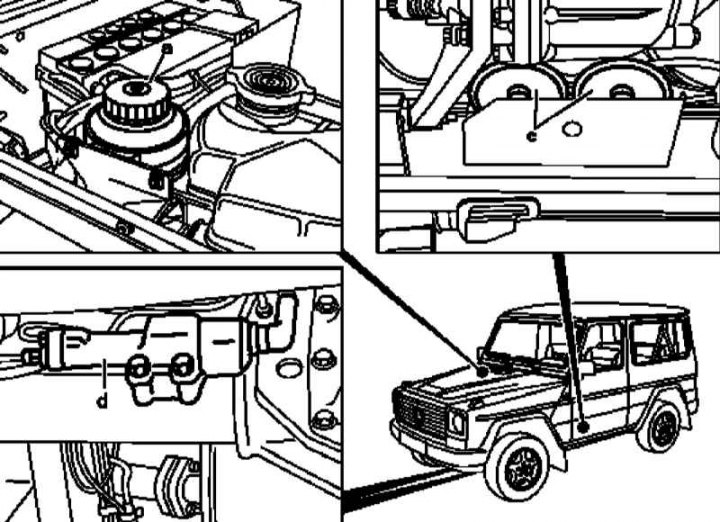
a - Reservoir; c - Pressure blocks for switching the interwheel differential locks of the front and rear axle assemblies; d - Actuating cylinders for switching the interwheel differential locks of the front and rear axle assemblies
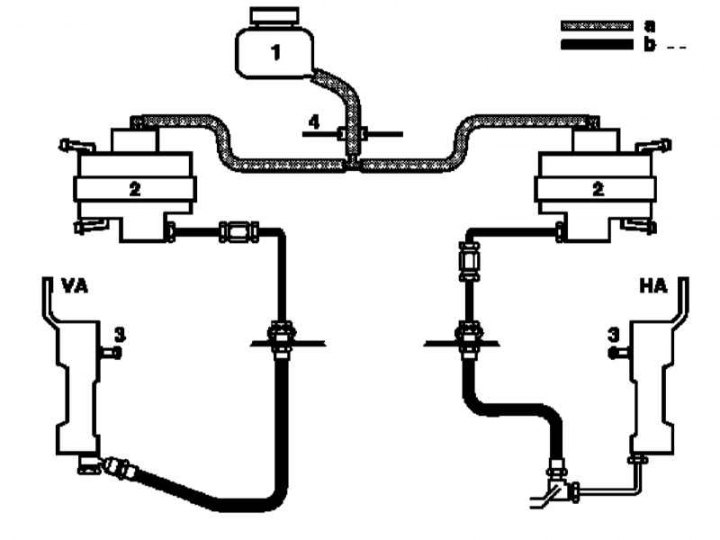
Functional diagram of the hydraulic differential lock drive
1 - Reservoir; 2 - Pressure blocks for switching the interwheel differential locks of the front and rear axle assemblies; 3 - Actuating cylinders for switching the interwheel differential locks of the front (VA) and rear (HA) axles; 4 - Right wheel arch; a - Hydraulic fluid supply circuit; b - Working contours of the actuator cylinders
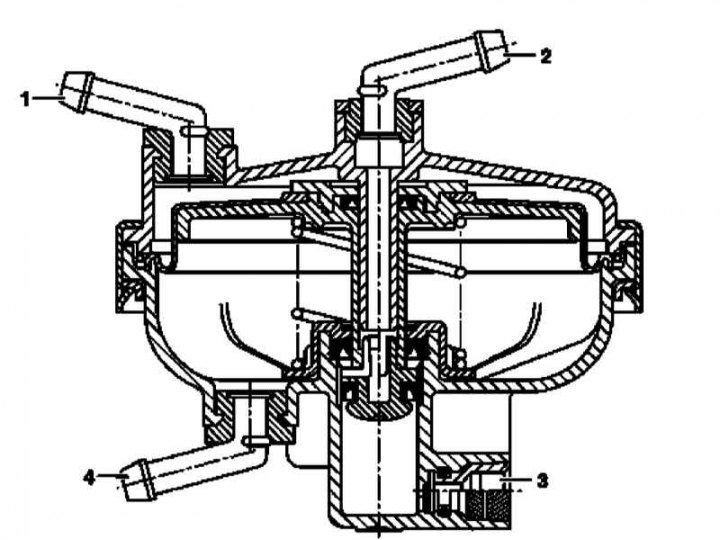
Construction of a hydropneumatic pressure unit
1 - Air access; 2 - To the hydraulic fluid reservoir; 3 - To the actuator cylinder of the locking control mechanism; 4 - Suction nipple (underpressure)
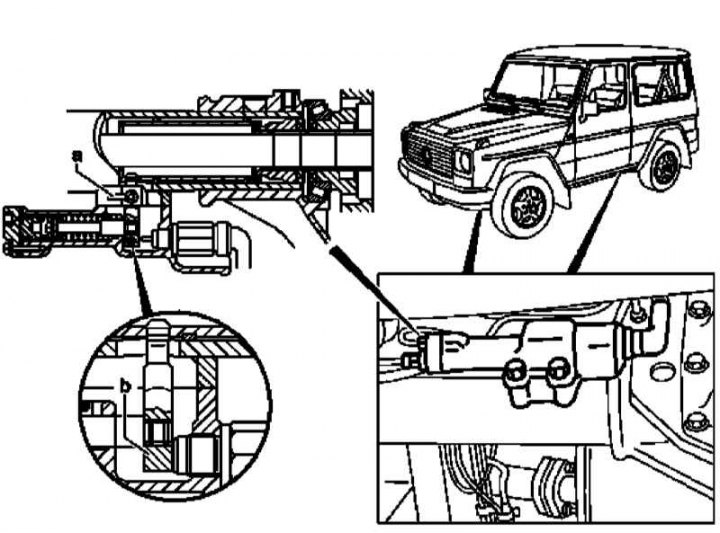
Schematic diagram of the arrangement of mechanical components of the interwheel differential lock control
a - Crankcase ventilation breather; b - Switch finger
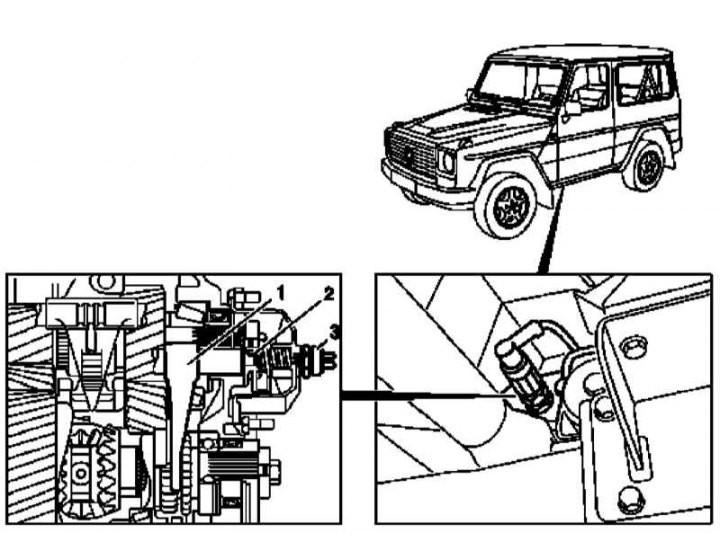
Schematic diagram of the mechanical components of the interaxle differential lock control
1 - Shift fork; 2 - Executive cylinder; 3 - Control switch (S76/2)
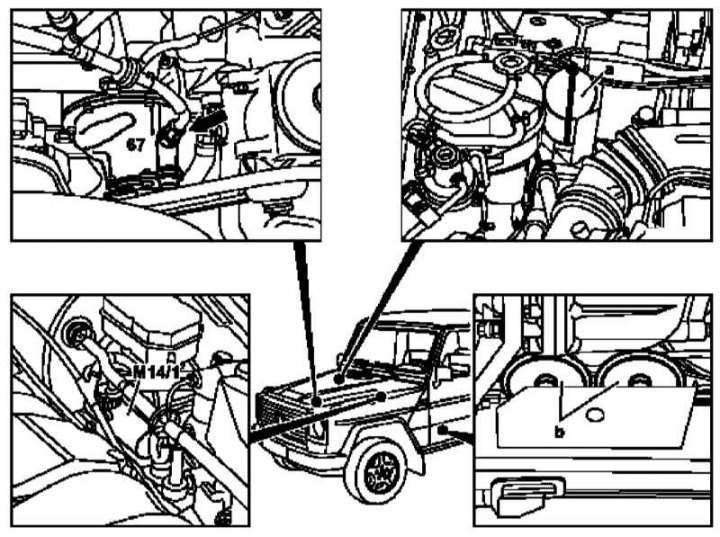
Layout of pneumatic components for differential lock control
M14/1 - Auxiliary vacuum pump (petrol models); 67 - Vacuum pump (diesel models); a - Vacuum receiver (0.4 l); b - Pressure blocks for switching the interwheel differential locks of the front and rear axle assemblies
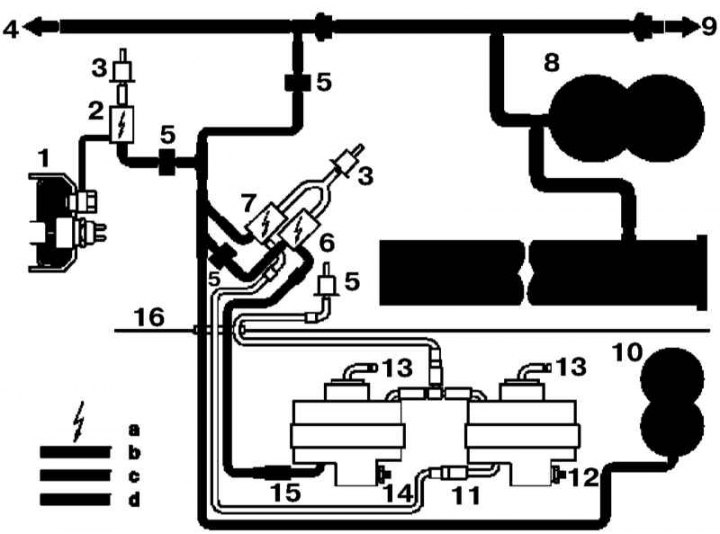
Functional diagram of the pneumatic differential lock drive on DIESEL models (interaxle differential and rear axle interwheel differential locks are enabled)
a - Element activated; b - Switching pressure; c - Feed pressure; d - Hydraulic pressure; 1 - Transfer case (center differential); 2 - Solenoid valve (Y68) for switching the center differential lock; 3 - Replacement filter for electromagnetic valve; 4 - To the vacuum pump; 5 - Check valve; 6 - Solenoid valve (Y68/1) for switching the rear axle interwheel differential lock; 7 - Solenoid valve (Y68/2) for switching the front axle interwheel differential lock; 8 - Brake system vacuum receiver in the frame cross member: 4.4 l (auxiliary vacuum receiver: 1.8 l); 9 - To the brake booster servo drive; 10 - Differential lock vacuum receiver (0.4 l); 11 - Pressure block for switching the front axle interwheel differential lock; 12 - Hydraulic control line nipple for the front axle center differential lock; 13 - To the hydraulic fluid reservoir; 14 - Hydraulic control line nipple for rear axle center differential lock; 15 - Pressure block for switching the rear axle interwheel differential lock; 16 - Right wheel arch
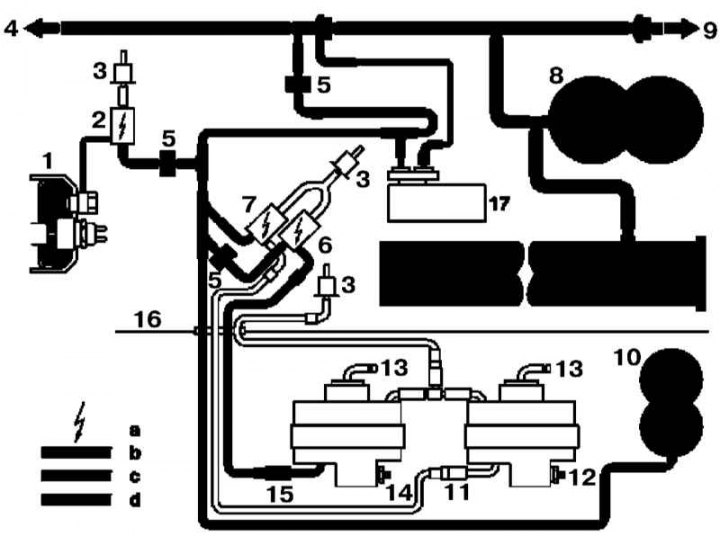
Functional diagram of the pneumatic differential lock drive on GASOLINE models (interaxle differential and rear axle interwheel differential locks are enabled)
a - Element activated; b - Switching pressure; c - Feed pressure; d - Hydraulic pressure; 1 - Transfer case (center differential); 2 - Solenoid valve (Y68) for switching the center differential lock; 3 - Replacement filter for electromagnetic valve; 4 - To the intake manifold; 5 - Check valve; 6 - Solenoid valve (Y68/1) for switching the rear axle interwheel differential lock; 7 - Solenoid valve (Y68/2) for switching the front axle interwheel differential lock; 8 - Brake system vacuum receiver in the frame cross member: 4.4 l (auxiliary vacuum receiver: 1.8 l); 9 - To the brake booster servo drive; 10 - Differential lock vacuum receiver (0.4 l); 11 - Pressure block for switching the front axle interwheel differential lock; 12 - Hydraulic control line nipple for the front axle center differential lock; 13 - To the hydraulic fluid reservoir; 14 - — Hydraulic control line nipple for rear axle center differential lock; 15 - Pressure block for switching the rear axle interwheel differential lock; 16 - Right wheel arch; 17 - Auxiliary electric vacuum pump (M14/1)
Differential Lock Control Electrical Component Layout Diagram (1 of 2)
1 - Center differential lock switch; 1.1 - Lock activation indicator light (yellow); 1.2 - Lock operation indicator light (red); 2 - Rear axle interwheel differential lock switch; 2.1 - Lock activation indicator light (yellow); 2.2 - Lock operation indicator light (red); 3 - Front axle interwheel differential lock switch; 3.1 - Lock activation indicator light (yellow); 3.2 - Lock operation indicator light (red); N30/2 - Differential lock control module; S76/2 - Control sensor-switch for interaxle differential lock; S76/3 - Rear axle differential lock control switch; S76/4 - Control switch for front axle differential lock

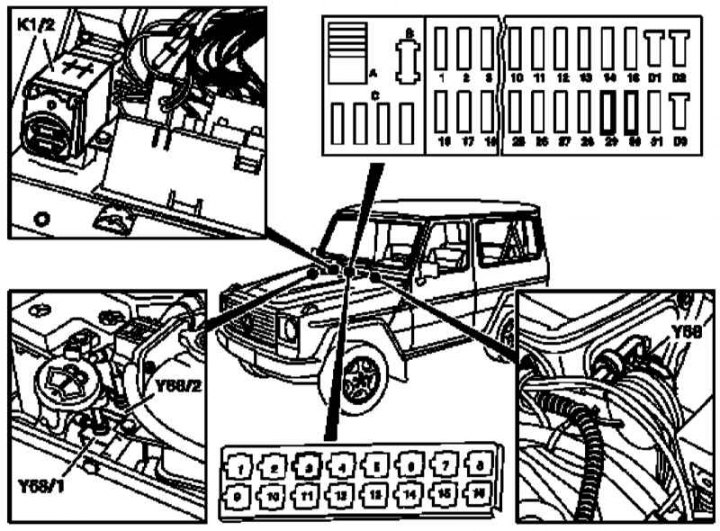
Differential Lock Control Electrical Component Layout Diagram (2 of 2)
3 - Relay (K36) for activating the auxiliary electric vacuum pump (M14/1) on petrol models; 29, 30 - Fuses; K1/1 = K1/2 (diesel models); K1/2 - Protection against electrical overloads (petrol models); Y68 - Interaxle differential lock switching solenoid valve; Y68/1 - Rear axle differential lock switching solenoid valve; Y68/2 - Solenoid valve for switching the front axle interwheel differential lock