
Cars BMW Cars Volkswagen Cars Chevrolet Cars Land Rover Cars Lada Cars Honda Cars Peugeot
English Русский
Български
Беларускі
Український
Српски
Hrvatski
Română
Polski
Slovenský
Magyar
Bookmark News and articles Sitemap Feedback Site search
MercedesMan.ru


A-Class C-Class E-Class G-Class M-Class S-Class Others
W116 (1972-1980, petrol) W126 (1979-1991, petrol) W140 (1991-1998) W220 (1998-2005)
  • Main
  • S-Class
  • W220 (1998-2005)
  • Chassis
  • Brake system
  • Basic information about the braking system

Basic information about the braking system (Mercedes-Benz S-Class W220)

0
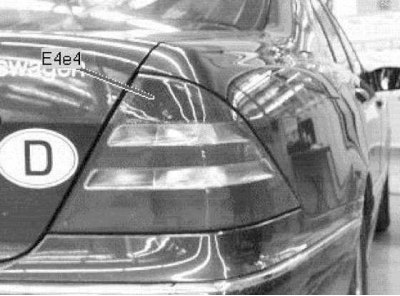
Brake light E4e4 in the rear light

Brake light E4e4 in the rear light


The hydraulic brake system consists of a master brake cylinder, a brake booster, and front and rear disc brakes. The brake system has two circuits. One circuit acts on the front brakes, the other on the rear. If one of the circuits fails, for example, due to a fluid leak, the car is braked by the other circuit. The fluid pressure in both circuits is created by a dual master brake cylinder, which acts from the brake pedal.

Description of the operation of the anti-lock brake systems ABS, Brake Assistance System BAS and Electronic Stability Program (anti-skid system) given in User manual.

The brake fluid reservoir is located under the master cylinder and supplies fluid to the entire hydraulic braking system.

The brake booster accumulates part of the vacuum created in the engine's intake manifold. Since a diesel engine lacks the necessary vacuum at the intake manifold, diesel-powered vehicles have a special vacuum pump. Using the appropriate valve, the force on the brake pedal is increased as needed due to the vacuum effect.

The pedal-operated parking brake acts via cables on the rear wheel brakes. Since the disc brake does not function as a parking brake, drum brakes are additionally installed on the rear wheels, integrated into the disc brakes. The drum brakes are activated only by the parking brake pedal.


Security measures


When cleaning the brake system, dust is released that can be harmful to human health, so you should not inhale brake dust.

(Article text obtained from the website: MercedesMAN)

Working with the brake system requires special cleanliness and strict adherence to instructions. If you do not have the necessary experience, it is advisable to contact a service station.

Note: When driving on wet roads, it is necessary to periodically press the brake pedal to remove moisture from the brake discs.


As the wheel rotates, moisture is thrown off the brake discs by centrifugal force, but a film of silicone, rubber abrasion products, grease and other contaminants remain, reducing the effectiveness of the brakes.

After installing new brake pads, the latter must be worked in. Therefore, for the first 200 km of running, you should not brake hard unless necessary.

Corroded disc brakes create a shaking effect when braking, which does not disappear over time. In this case, it is necessary to replace the brake discs.

Dirt burning onto the surface of the brake pads and rain grooves cause grooves to form on the surface of the brake discs, which results in reduced braking efficiency.
This article is available at: russian, bulgarian, belarusian, ukrainian, serbian, croatian, romanian, polish, slovak, hungarian
The article has been verified: Khromov Roman Mikhailovich
Share with friends:
◀ Previous
S-Class W220 / Brake system
Next ▶

 
Brake system specifications
Location of Emergency brake booster BAS components
Location of ESP system components
Dual master cylinder
Vacuum booster — removal, inspection and installation
More similar articles for repairing other models

☛ General description of the braking system Mercedes W168 (1997-2004)
☛ Pierburg 2E-E carburetor fuel system — basic information and… Mercedes 190 (W201) (1982-1993)
☛ Cooling system — general information Mercedes W123 (1976-1985)
☛ General information about the charging and starting system Mercedes W463 (1999-2019)
☛ Radio (basic, with emergency call system) (ML 430) Mercedes W163 (1997-2005)
☛ Brake System Maintenance — General Information Mercedes Sprinter (1995-2000, diesel)
Link in different formats to this article
Comments and feedback from visitors
No comments yet


How much will 44 + 34 ?


W220 (1998-2005) 
  • General information
  • Introduction to guide
  • User manual
  • Maintenance
  • Power unit
  • Engine repair
  • Cooling and heating systems
  • Power and exhaust systems
  • Ignition and control system
  • Charge and launch systems
  • Transmission
  • Automatic gearbox
  • Drive shafts
  • Chassis
  • Brake system
  • Front suspension
  • Rear suspension
  • Steering
  • Body
  • Body elements
  • Electrical equipment
  • Equipment and devices
  • Electrical circuits
W140 (1991-1998) 
  • User manual
  • Controls and instruments
  • Driving and operation
  • Maintenance
  • Power unit
  • Petrol engine V6
  • Petrol engine V8
  • Petrol engine V12
  • Diesel engine OM603
  • Diesel engine OM606
  • Cooling system
  • Power supply and injection system
  • Control system HFM-SFI
  • Control system LH-SFI
  • Control systems ME-SFI
  • Diesel control system
  • Ignition system
  • Charge and launch system
  • Transmission
  • Mechanical gearbox 717.438
  • Mechanical gearbox 717.454
  • Automatic gearbox 722.5
  • Automatic gearbox 722.6
  • Clutch and drive shafts
  • Differential
  • Chassis
  • Brake system
  • Steering
  • Front suspension
  • Rear suspension
  • Body
  • Exterior (external elements)
  • Interior (internal elements)
  • Electrical equipment
  • Equipment and devices
  • Electrical circuits
W126 (1979-1991, petrol) 
  • Power unit
  • Engine repair
  • Ignition system
  • Lubrication system
  • Cooling system
  • Fuel system
  • Fuel injection system
  • Transmission
  • Clutch and cardan
  • Mechanical gearbox
  • Automatic gearbox
  • Chassis
  • Front suspension
  • Rear suspension
  • Steering
  • Brake system
  • Electrical equipment
  • Power devices
  • Electrical circuits
W116 (1972-1980, petrol) 
  • General information
  • Introduction to guide
  • Power unit
  • 8-cylinder V8 engine
  • 6-cylinder I6 engine
  • Cooling and lubrication system
  • Power system (carburetor)
  • Fuel injection system
  • Ignition system
  • Transmission
  • Clutch and cardan
  • Car gearbox
  • Chassis
  • Front suspension
  • Rear suspension
  • Steering
  • Brake system
  • Electrical equipment
  • Power devices
  • Electrical circuits
 
MercedesMan.ru © 2017–2026 · Mobile version · Read about Mercedes · Sitemap: EN BG BY UA RS HR RO PL SK HU · Feedback · Site search · Bookmark A-Class (W168) · C-Class (W201) · C-Class (W202) · C-Class (W203) · E-Class (W123) · E-Class (W124) · E-Class (W210) · G-Class (W463) · M-Class (W163) · S-Class (W116, petrol) · S-Class (W126, petrol) · S-Class (W140) · S-Class (W220) · Sprinter · Vito 1 · Vito 2 · Vario 814D ·
 
We only use cookies without which some of the site's features may not be available.