



Attention! The illustrations show the thermostat removed from the housing. In A-class cars, the thermostat and housing form a single unit.
Thermostat operating principle
As the engine temperature increases, the thermostat opens a large coolant circulation circuit.
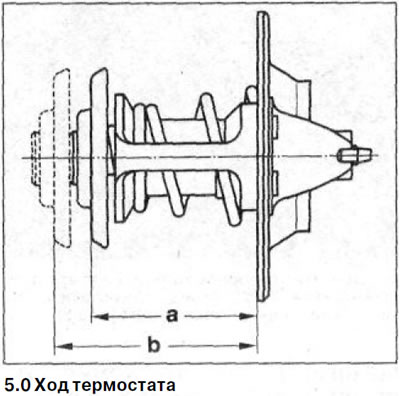
At the same time, the thermostat spring gradually stretches and the length of the thermostat increases (see distance a and b in illustration 5.0).
If, due to a malfunction, the thermostat does not work, the engine will overheat.
This situation is signaled by the coolant temperature indicator on the instrument panel, the arrow of which enters the range of maximum temperatures. At the same time, the radiator remains cold.
A faulty thermostat may remain in the open position after the coolant has cooled.
(Original article is on the portal: www.mercedesman.ru)
This thermostat defect can be identified by the fact that the engine does not warm up to operating temperature or by a drop in the intensity of interior heating in winter.
Examination
Attention! This test only allows you to determine whether the thermostat opens when heating, and whether it closes when cooling.
1. Remove the thermostat.
2. Check the position of the thermostat through the connecting pipe.
3. Heat the thermostat housing by placing it in a container with water. The thermostat should not touch the walls of the container (see illustration).
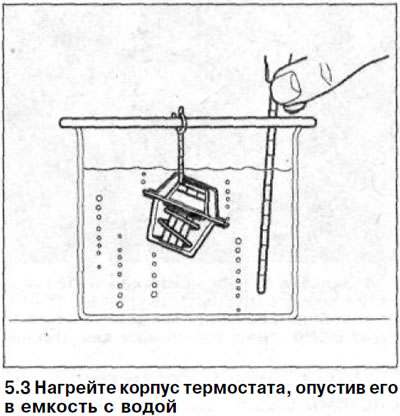
4. Monitor the water temperature in the tank with a thermometer. Once the water in the tank reaches the boiling point, carefully remove the thermostat housing and check the height of the thermostat through the connecting pipe.
The thermostat should open and the hole for the coolant to flow to the radiator should be completely clear. Otherwise, replace the housing and thermostat.
5. Make sure that the thermostat closes completely when cooling down. If not, replace the thermostat.