



The collected air enters the heater radiator and is heated there, or the air conditioner evaporator, where it is cooled, and from there, already heated or cooled, it enters the deflectors in the cabin through the air distribution flaps.
The deflectors on the instrument panel supply warm air to the windshield and to the windshield wiper blades in their initial position. This ensures that the rubber bands of the wipers are warmed up in winter and that ice is removed from them.
Hot coolant constantly circulates in the heater radiator, heating it.
The fresh air passing through the heater radiator takes this heat and thus warms up.
The temperature of the air supplied to the passenger compartment is regulated by proportional mixing of hot and cold air.
Thus, the operation of the heater depends on the air temperature (see illustration 10.0). The air distribution flaps of the heater are driven by actuator electric motors or cable rods. To increase air exchange in the car's interior, the fan can operate at four speed modes.
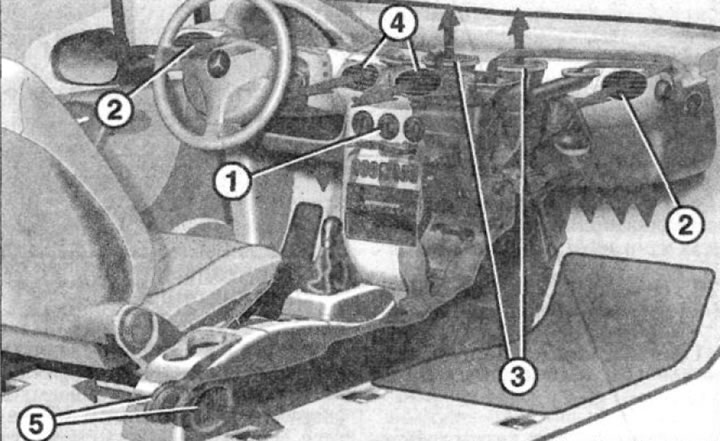
10.0 Heating and ventilation of the passenger compartment
1 - heater/air conditioner switch panel
2 - side deflector
3 - windshield blower deflectors
4 - central deflectors
5 - rear air deflectors
For this purpose, each stage of rotation of the fan electric motor has a corresponding additional resistance. If one of the additional resistances fails, the resistance board is subject to replacement as a set.
If, for example, due to pollution of the outside air, it is necessary to turn off its intake, then the air recirculation mode can be maintained in the car's interior, i.e. only the air in the interior will be used.
Attention! If work on the heater also involves work on electrical equipment, then it is imperative to disconnect the ground (-) wire terminal from the negative pole terminal. Even the simple disconnection of a wire or connecting terminal is considered work on electrical equipment.
A-class cars with a diesel engine, starting from 01/03, are additionally equipped with an electric heater, which is a heating element located in the heater radiator.
When the air temperature drops below +8°C, the electric heater turns on automatically and warms the air in the cabin to the set temperature, and then turns off.
Air conditioner
The air conditioner operates on the same principle as a refrigerator.
Compressor 7 (see illustration 10.0a) compresses the gaseous, environmentally friendly and freon-free refrigerant R-134A.
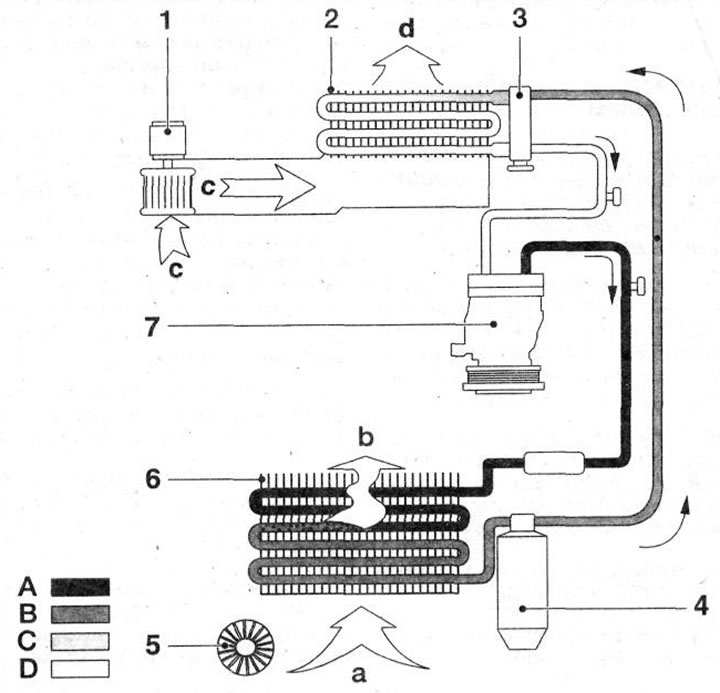
10.0a Air conditioner and its operating principle
1 - blower fan
2 - evaporator
3 - throttle valve
4 - container with refrigerant
5 - radiator cooling fan
6 - radiator
7 - compressor
a - air flow when the car is moving, cooling the radiator
b - hot air
c - uncooled air supplied by the fan
d - cooled air supplied to the cabin
A - high pressure (refrigerant in gaseous state)
B - high pressure (refrigerant in liquid state)
C - low pressure (refrigerant in liquid state)
D - low pressure (refrigerant in gaseous state)
As a result, the coolant heats up and enters the radiator, where it cools and liquefies.
Through the throttle valve 3, the refrigerant is supplied to the evaporator 2, where the resulting liquid again passes into a gaseous state. In this case, it is strongly cooled, as a result of which the air taken from the outside is also cooled. At the same time, the moisture contained in the air is converted into condensate, which is discharged outside.
The intensity of air cooling depends on the set temperature in the cabin, as well as on the speed of the blower fan.
The air conditioner can operate on the "Reheat" principle (reheating) air.
When the ambient air temperature is above +1°C, the air conditioner compressor operates, which means that the air conditioner first cools the incoming air and then heats it on the evaporator to the required temperature.
When cooling, the air is dried, which prevents the glass from fogging up.
Upon request, A-class cars can be equipped with automatic air conditioning.
Attention! Maintenance and repair of the air conditioner should only be entrusted to a specialized workshop.
Warning! Do not open the air conditioner refrigerant circulation system. Contact with the coolant on the skin causes frostbite. If the refrigerant comes into contact with the skin, immediately rinse the skin with cold water for at least 15 minutes. The refrigerant is colorless, odorless, and heavier than air. If the refrigerant leaks, people in the area of the floor on which the vehicle is installed or in rooms located below the leak may suffocate.