



This is necessary so that particles of anti-corrosion protection settle on new parts made of light metals during the running-in period and thus form a strong anti-corrosion film.
The old coolant no longer contains enough anti-corrosion agent to form a protective layer on new parts.
A routine coolant change is performed as part of vehicle maintenance. Warning! Coolant is poisonous. It must not be poured out in random places. To do this, you need to find out where the nearest collection point for special means is or hand over the coolant to the disposal point.
Draining the coolant
Warning! Jacking up the vehicle and placing it on stands may pose a risk of injury. Familiarize yourself with the safety precautions before raising the vehicle, see chapter "Jacking up a car".
1. Place the vehicle on jack stands so that it is level.
Caution! When the engine is hot, place a thick cloth on the radiator filler cap before removing it to avoid being burned by hot coolant or steam. Remove the cap only when the coolant temperature is below +90°C.
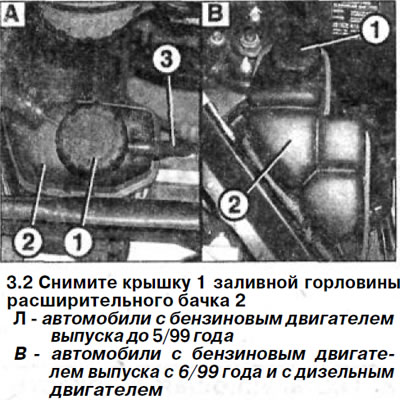
2. Remove the cap 1 of the filler neck of the expansion tank 2 (see illustration). When performing this operation, place a rag on the cap, press the cap down and turn it to the left to release the pressure in the system. Then unscrew the cap completely.
3. Place a clean container under the radiator to collect the coolant.
4. Unscrew the plug 3 of the radiator drain hole and drain the coolant into a container (see illustration).
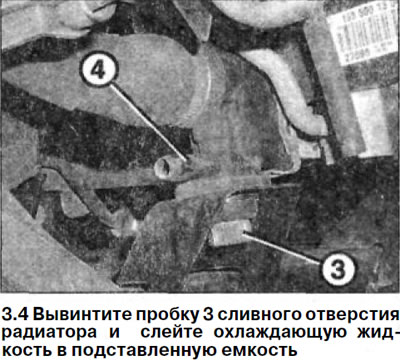
Attention! To prevent the coolant from splashing when draining in this way, it is recommended to attach a suitable hose to the nipple 4 (see illustration 3.5).
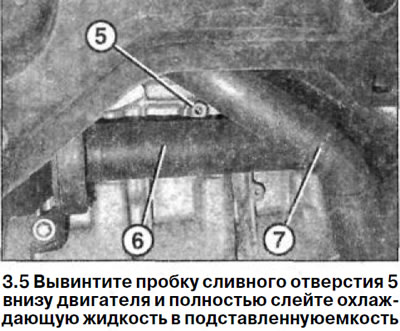
5. Unscrew the drain plug 5 at the bottom of the engine and completely drain the coolant into a container. The plug is located behind the intermediate shaft 6 of the axle shaft and the exhaust manifold 7 (see illustration).
6. Completely drain the coolant from the system.
7. Screw in the radiator drain plug and the engine block plug. The tightening torque for the engine block plug is 10 Nm.
8. Lower the car onto its wheels.
Refueling
9. Prepare new coolant.
10. If present, unscrew the vent plug on the heater hose connection fitting.
11. Fill the coolant through the filler neck of the expansion tank.
Caution: Add coolant slowly to avoid air lock formation.
12. Screw in the vent plug, if available, onto the heater hose connection fitting when coolant starts to flow out of it.
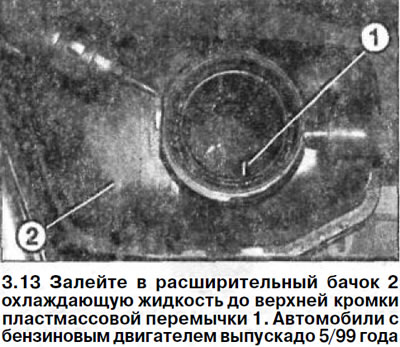
13. Cars with a petrol engine manufactured before 5/99. Fill the expansion tank 2 with coolant up to the upper edge of the plastic jumper 1 (see illustration).
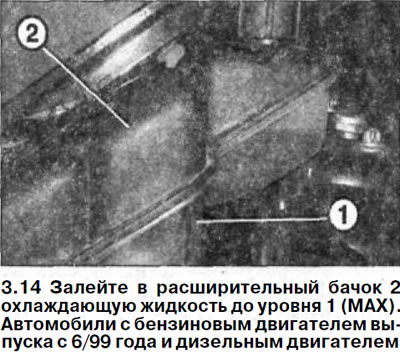
14. Cars with petrol engine manufactured since 6/99 and diesel engine. Fill expansion tank 2 with coolant to level 1 (MAX) (see illustration).
(Article was borrowed from the website: MercedesMan.ru)
Bleeding air from the cooling system
15. Start the engine without closing the filler neck of the expansion tank with the cap and let it idle.
16. Move the interior heating control to the maximum heating power position.
17. Top up the coolant level in the expansion tank so that its level is level with the MAX mark on the tank.
18. Let the engine idle until the coolant temperature reaches 60°-70°C or until the upper radiator hose is warm.
19. Close the filler neck of the expansion tank with the cap.
20. Increase the engine speed to 1500-2000 and leave it running at this speed until the radiator fan turns on and off.
21. Turn off the engine.
22. Check the cooling system for leaks, especially at the hose connections, drain plug and water pump.
23. Let the engine cool down and check the coolant level in the expansion tank. Top up the coolant if necessary.