Cars BMW Cars Volkswagen Cars Chevrolet Cars Land Rover Cars Lada Cars Honda Cars Peugeot
English Русский
Български
Беларускі
Український
Српски
Hrvatski
Română
Polski
Slovenský
Magyar
Bookmark News and articles Sitemap Feedback Site search
MercedesMan.ru


A-Class C-Class E-Class G-Class M-Class S-Class Others
W463 (1999-2019)
  • Main
  • G-Class
  • W463 (1999-2019)
  • Power unit
  • Engine repair
  • Checking the engine with a vacuum gauge

Checking the engine with a vacuum gauge (Mercedes-Benz G-Class W463)

0
Using a vacuum gauge, you can get information about the condition of the engine and determine if the cylinder head gasket is blown, the fuel system is damaged, the rings are damaged, the fuel system is incorrectly adjusted, the valves are damaged, etc. Unfortunately, the readings of the vacuum gauge can be misinterpreted, so these measurements must be used in combination with other methods of checking the engine. For a correct determination, both the absolute value of the vacuum gauge readings and the rate of their change are important.

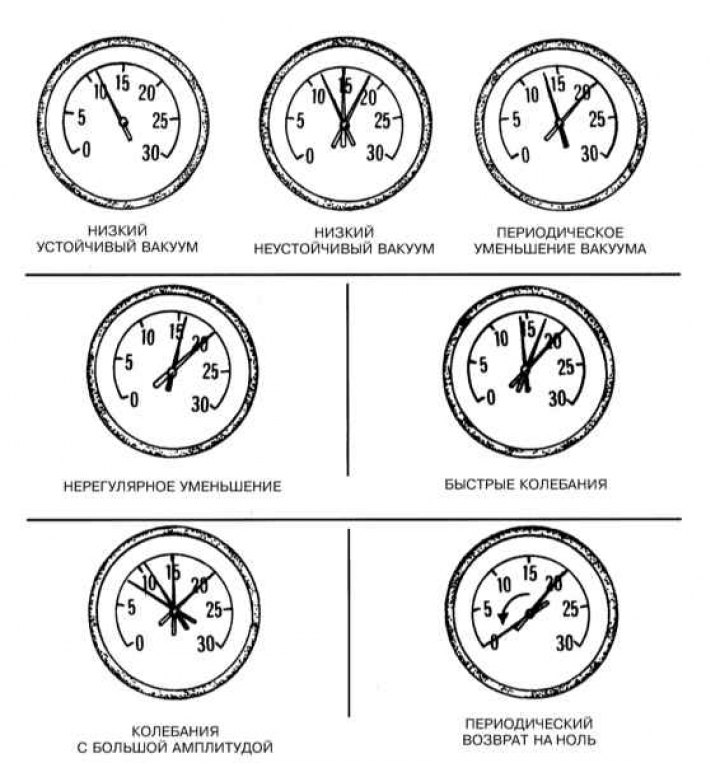
Basic positions and fluctuations of the vacuum gauge needle when diagnosing engine faults

Basic positions and fluctuations of the vacuum gauge needle when diagnosing engine faults


1. Connect a vacuum gauge to the intake manifold. Start and warm up the engine to normal operating temperature.

2. Read the vacuum gauge readings:
  • If the engine is in normal condition, the vacuum gauge reading should be 430-560 mm Hg, and the vacuum gauge needle should remain in place.
  • Low constant readings vacuum gauge indicate that the gasket between the intake manifold and the throttle body is damaged, the vacuum hose is damaged, the ignition timing is incorrectly set, or the valve timing is incorrectly set.
  • If the vacuum gauge readings below the norm by 80 - 200 mm Hg and fluctuate, then the intake manifold gasket near the inlet may be damaged or the injector may be faulty.
  • If the readings constantly fall by 50 - 100 mm Hg relative to the stable value, then the valves may be damaged. In this case, it is necessary to measure the compression in the engine cylinders.
  • If the readings they fall, but not regularly, then perhaps the valve is jammed or there is an ignition failure.
  • If the readings fluctuate rapidly with an amplitude of about 100 mm Hg, at constant idle speed, and smoke comes out of the exhaust pipe, the valve guides may be damaged.
  • If the readings fluctuate rapidly as idle speed increases, then the intake manifold gasket or cylinder head gasket may be damaged, the valve springs may be weak, the valves may be burnt, or there may be an ignition failure.
  • Small fluctuations of about 25 mmHg. are usually associated with failures in the ignition system.
  • If the readings fluctuate greatly, then the cylinder head gasket or cylinder may be damaged.
  • If the arrow moves slowly within a wide range of values, then the crankcase ventilation system may be clogged, the intake manifold gasket or the gasket between the throttle body and the manifold may be damaged.

3. Check how quickly the vacuum gauge readings recover after the throttle valve is opened sharply and fully and returned to its original position. If the engine is in normal condition, the readings will drop to almost zero, then increase by about 130 mm Hg above normal and again decrease to the previous values at constant idle speed. If the readings recover slowly and pass through the maximum after closing the throttle valve, then the piston rings may be damaged. If there is a long delay, then the exhaust system may be clogged.

(Text republished from the website: MercedesMAN)
This article is available at: russian, bulgarian, belarusian, ukrainian, serbian, croatian, romanian, polish, slovak, hungarian
The article has been verified: Polyakov Zakhar Grigorievich
Share with friends:
◀ Previous
G-Class W463 / Engine repair
Next ▶

Checking compression pressure, assessing the condition of the cylinders
Engine specifications
Replacement of the auxiliary drive belt and elements of its tensioning mechanism
Checking engine oil pressure
Calculating oil consumption
Checking and adjusting the basic position of the camshafts
Checking the basic position of the balance shaft (M112 and 628 engines only)
More similar articles for repairing other models

☛ Checking the engine oil level using a dipstick Mercedes W168 (1997-2004)
☛ Checking the engine with a vacuum gauge Mercedes W203 (2000-2007)
☛ Checking the technical condition and repairing the engine Mercedes W123 (1976-1985)
☛ Checking the engine with a vacuum gauge Mercedes W163 (1997-2005)
☛ Checking the engine with a vacuum gauge Mercedes W140 (1991-1998)
☛ Checking the engine oil level Mercedes Sprinter (1995-2000, diesel)
Link in different formats to this article
Comments and feedback from visitors
No comments yet


How much will 31 + 43 ?


W463 (1999-2019) 
  • General information
  • Introduction to the guide
  • Controls and instruments
  • Driving and operation
  • Maintenance
  • Power unit
  • Engine repair
  • Cooling system
  • Heating and ventilation
  • Power system (gasoline)
  • Fuel system (diesel)
  • Exhaust system
  • Ignition and control system
  • Charging and starting system
  • Transmission
  • Automatic gearbox
  • Transfer case
  • Axles front and rear
  • Chassis
  • Brake system
  • Front suspension
  • Rear suspension
  • Steering
  • Body
  • Exterior (external elements)
  • Interior (internal elements)
  • Doors, locks and windows
  • Electrical equipment
  • Equipment and devices
  • Switches in salon
  • Headlights and lighting
  • Audio system and navigation
  • Electrical circuits
 
MercedesMan.ru © 2017–2026 · Mobile version · Read about Mercedes · Sitemap: EN BG BY UA RS HR RO PL SK HU · Feedback · Site search · Bookmark A-Class (W168) · C-Class (W201) · C-Class (W202) · C-Class (W203) · E-Class (W123) · E-Class (W124) · E-Class (W210) · G-Class (W463) · M-Class (W163) · S-Class (W116, petrol) · S-Class (W126, petrol) · S-Class (W140) · S-Class (W220) · Sprinter · Vito 1 · Vito 2 · Vario 814D ·
 
We only use cookies without which some of the site's features may not be available.