



When faults are indicated, the fuses should be checked first, and only then the corresponding relays.
The purpose of the fuses is indicated on the block. The corresponding information is also available in the appendix to the vehicle operating instructions.
1. Disconnect all power consumers and turn off the ignition before replacing the fuse.
2. Open the fuse box.
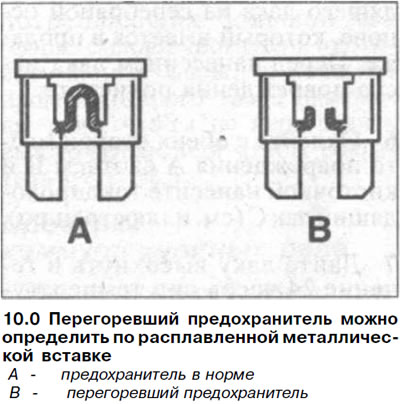
A blown fuse can be identified by the melted metal insert (see illustration 10.0).
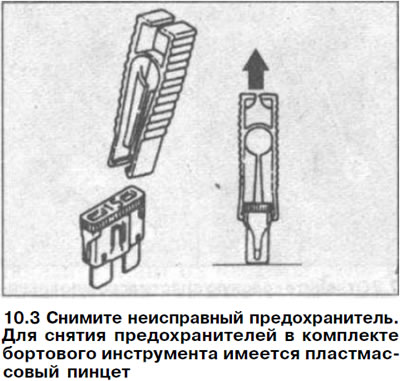
3. Remove the faulty fuse. The on-board tool kit includes plastic tweezers for removing fuses (see illustration).
4. Insert a new fuse rated for the same amperage as the blown fuse. The fuse rating is indicated on the back of the housing. In addition, the housing of fuses of this type has markings applied in paint, the color of which corresponds to a certain rating.
Information copied from the website [www.mercedesman.ru]
| Nominal current | Color coding |
| 5 A | beige |
| 7.5 A | brown |
| 10 A | red |
| 15 A | blue |
| 20 A | yellow |
| 25 A | white |
| 30 A | green |
| 40 A | amber |
| 60 A | blue |
| 80 A | yellow |
Caution! Fuses with a rated current of over 40 A may have the same distinctive coloring as fuses with a lower rating. However, fuses with a rating of over 40 A are larger in size, which helps to avoid mistakes when replacing them. In addition, large fuses are difficult to remove from the holders on the block.
Spare fuses are included in the on-board tool kit. It is recommended to replenish the carried kit as the spare fuses are used up.
If the new fuse also burns out after a short period of time, the corresponding electrical circuit must be checked.
Never replace fuses with wire or other similar means, as this may cause serious damage to electrical equipment.