



If necessary, additionally secure newly laid wires with electrical tape, plastic mass, tape clamps, etc. to avoid noise during movement and to prevent them from fraying.
In this case, special attention should be paid to ensuring that there is a distance of at least 10 mm between the brake pipes and the secured wires.
The distance between the brake lines and the wires that vibrate with the engine or other parts of the vehicle must be at least 25 mm.
When drilling holes in the body to install additional electrical equipment, the edges of the holes must be deburred, primed and varnished. Any falling chips must be removed immediately and completely.
When performing any work involving electrical wiring, to avoid short circuits, be sure to disconnect the negative battery terminal (-) and place it away from the work area.
Caution! When the battery is disconnected, some electrical devices such as the radio or clock are switched off, or the information recorded by the self-diagnosis unit of the engine management system, automatic transmission and anti-lock braking system (ABS) is deleted. Special instructions on this topic are given in Chapter "Removal the battery".
If additional current consumers are installed, it is necessary to check in each case whether the existing alternator can withstand the additional load. If necessary, install a more powerful generator.
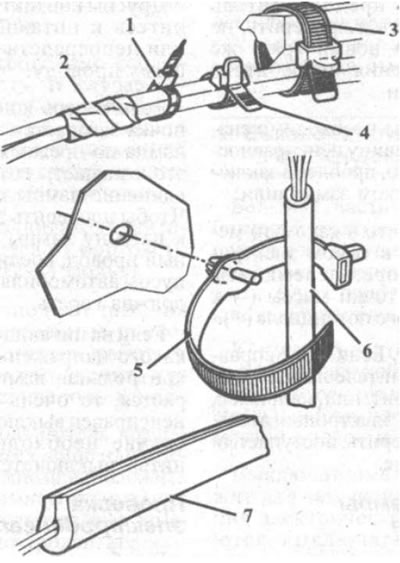
2.0 Fastener samples
1 - tape clamp
2 - electrical tape
3 - clamping clamp
4 - clamping clamp
5 - clamp with a hole for fastening
6 - protective (insulating) hose
7 - self-adhesive foam tape