



Contents: Measuring instruments ↡ Taking measurements ↡
When checking electrical equipment, a motorist, referring to technical documentation, constantly encounters such concepts as voltage, current, resistance.
Voltage is measured in volts (V), current in amperes (A), and resistance in ohms (Ω).
In automotive engineering, voltage is usually understood to mean the voltage of the battery. In this case, we are talking about a direct current voltage of approximately 12 V.
The battery voltage value depends on the degree of its discharge and the ambient air temperature. Battery voltage can fluctuate within 10-13 volts.
The on-board voltage is generated by the generator. At average engine speeds it is about 14 V.
The concept of current strength in automotive engineering occurs relatively rarely. Current strength is indicated, for example, on fuses.
The current rating represents the maximum current that can flow through the fuse without causing it to blow or break the electrical circuit.
Wherever current flows, it must overcome resistance. Resistance depends, among other things, on the following factors: the cross-section and length of the conductor, its material, the current consumed, etc.
If the resistance is too high, it may cause a malfunction.
For example, the resistance of the high-voltage wires of a gasoline engine should not be too high, because in this case the spark plugs will not be able to generate a sufficiently powerful spark that will ignite the air-fuel mixture, thereby starting the engine.
Caution! Before starting work on the electrical system, be sure to disconnect the terminal from the negative pole of the battery, see chapter "Battery - Removal and Installation". Work on the electrical system is considered to be the simplest disconnection of an electrical wire.
Measuring instruments
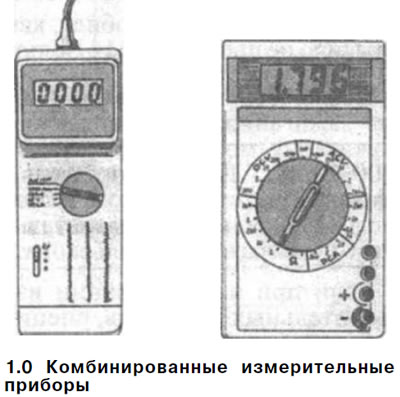
To perform the measurements required for vehicle servicing, so-called combined measuring instruments are available commercially.
They combine a voltmeter for measuring voltage, an ammeter for measuring current, and an ohmmeter for measuring resistance.
The devices available on the market differ from each other mainly in their measurement ranges and accuracy.
The measurement range determines the limits within which the measured value of voltage or resistance must be in order for it to be registered by the device at all.
For car enthusiasts involved in repairs, there are combined measuring devices specially designed for performing control measurements on cars.
With the help of such a device, it is possible to measure the engine speed, the angle of the closed state of the ignition system breaker contacts, as well as voltage up to 20 V. Such a device, as a rule, can measure resistance in the range of up to one kilo-ohm, i.e. from 1 to 1000 Ohm.
In addition, devices for testing electrical and electronic components are offered. They allow measuring both small resistances of several Ohms and large ones, in the megaohm (mOhm) range. With these devices, it is possible to measure voltages (in volts) with very high accuracy, which is especially necessary when testing electronic units.
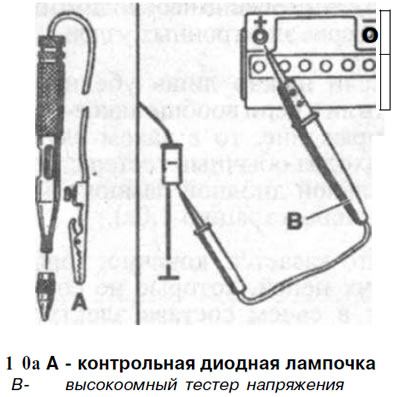
If you just need to make sure whether there is any voltage in the circuit at all, then a regular tester with a control diode lamp A is suitable (see illustration 1.0a).
This, of course, only applies to circuits that do not contain electronic components, since electronic devices are extremely sensitive to excessively high currents. Sometimes electronic elements fail already at the moment of connecting such a control lamp.
Attention! To check the voltage in circuits containing electronic components (transistors, diodes, relays) high resistance voltage tester required (see illustration 1.0a). It performs almost the same task as a test light, but does not damage electronic circuits and is suitable for performing any tests.
Taking measurements
Voltage measurement
The presence or absence of voltage can be checked with a simple test light or tester. Of course, this can only check the voltage when it is present. To check the magnitude of the voltage present, you need to connect a voltmeter.
First, the voltmeter must be set to a measurement range that corresponds to the expected value of the measured voltage.
Voltages in a car usually do not exceed 14 volts. An exception is the ignition system, where the ignition voltage can reach 30,000 volts. Such voltage can only be measured with a special measuring device or oscilloscope.
If, when using measuring instruments specifically designed for control measurements on cars, it is sufficient to turn on, in this case, the voltmeter, by pressing a button, then when using combined control and measuring instruments, it is necessary to first make a number of decisions.
First, you need to select the DCV voltage measurement mode, as opposed to the ACV mode - alternating current voltage measurement. Then, select the measurement range. Since there are no voltages higher than 14 V in the car, except for the ignition system, you can select the upper measurement limit, slightly higher than this value (approximately 15-20 volts).
If it is known for sure that the measured voltage is significantly lower, for example, in the region of 2 volts, then the device can be switched to a lower range, which will allow for greater measurement accuracy.
If the voltage to be measured is higher than the range selected, the measuring instrument may be damaged.
Connect the measuring device wires as shown in Illustration 1.0b, parallel to the current consumer. In this case, the red measuring device wire is connected to the wire coming from the positive terminal of the battery, and the black wire of the device is connected to the wire going to the "ground" (-) or the car body, for example, the cylinder block.
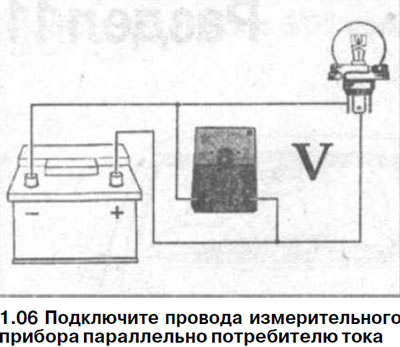
Example of verification:
If the engine starts abnormally because the starter speed is too low, it is advisable to check the battery voltage with the starter running.
To do this, the red wire of the voltmeter (+) must be connected to the positive pole of the battery, and the black wire to the car body (-).
Then ask an assistant to operate the starter and read the voltmeter reading.
If the voltmeter registers a voltage of at least 10 volts (at a battery temperature of +20°C), then the battery needs to be checked and perhaps charged before making further attempts to start the engine.
Measuring current
It is comparatively rare to have to measure the current strength. An example of measurements is given in the chapter "Self-discharge of the battery". For this, an ammeter is needed, which can also be a component of combined control and measuring devices.
Before measuring the current, the measurement range corresponding to the expected value of the measured current is set on the device. If the current is unknown, then the highest limit must be set and, if the device does not show any current, the device must be successively switched to measurement ranges of increasingly smaller currents.
To measure current, the electrical circuit, as shown in Figure 1.0b, must be broken and the measuring device (ammeter) must be connected across the break in the circuit.
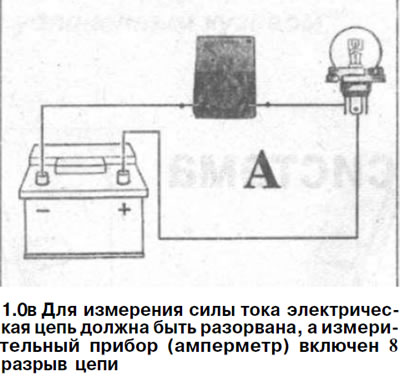
To do this, for example, disconnect the plug and connect the red wire (+) of the ammeter to the power supply wire. Connect the black wire (-) of the ammeter to the contact to which the disconnected wire was connected.
The ground contact (-) between the plug and the current consumer should be shorted with an auxiliary wire.
Warning! Never measure the current on the starter wire with a regular ammeter (about 150 A) or to the glow plugs of a diesel engine (up to 60 A), because the large currents flowing in this case can damage the device. In workshops, current clamps are used for such measurements. The clamps are connected to an insulated wire and the current is measured using the phenomenon of induction.
Measuring resistance
Before measuring, you must make sure that the contacts to which the ohmmeter is connected are not under voltage. This means that you should always disconnect the battery first. Otherwise, you can damage the measuring device.
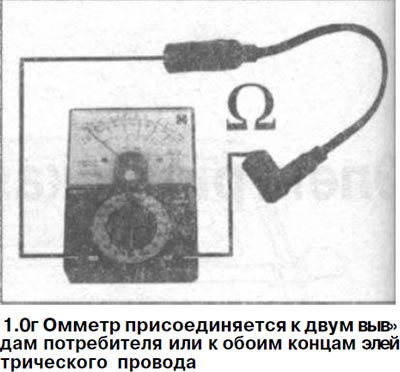
The ohmmeter is connected to the two terminals of the consumer or to both ends of the electrical wire. It does not matter which wire of the ohmmeter (+) or (-) is connected to one or another contact (see illustration 1.0g).
Resistance measurement in the automotive industry is limited mainly to two areas:
1. Checking the resistance or any other part included in the electrical circuit.
2. "Ringing" of an electric wire, switch, or heating element coil. This checks whether any wire is broken and whether this is the cause of failure of the device connected to it. To measure, an ohmmeter is connected to both ends of the wire being checked. If the resistance is 0 Ohm, the wire is OK. If the wire is broken, the device shows ∞ Ohm (infinite resistance).