



Note: See also Part Comfort Chapters Governing bodies.
The air supplied by the ventilation system to the car's interior through the filter can be heated or cooled depending on the choice of the driver and passengers. The heater or air conditioner is located in the interior, in the housing under the instrument panel. The entire flow of air supplied to the interior is directed for heating or cooling through the same casing. The temperature and speed of the air flow are regulated using the controls located on the control panel.
The heat generated by the engine is transferred by the coolant to the heater radiator located in the passenger compartment. The air flow supplied by the ventilation system passes through the radiator and is heated by the heat of the engine coolant flowing inside the radiator. The degree of heating is regulated by mixing cold and hot air in a certain ratio using a servo-driven mixing flap.
Used air is removed from the passenger compartment through ventilation openings with check valves.
The fresh air fan increases the air flow through the heat exchanger.
If it is necessary to turn off the fresh air supply, for example due to a bad smell, the system switches to recirculation mode, in which only the air that is present in the cabin circulates.
Switching the system to recirculation mode is confirmed by activation of the indicator lamp (see Chapter Controls and safe operating techniques).
Interior air conditioning system
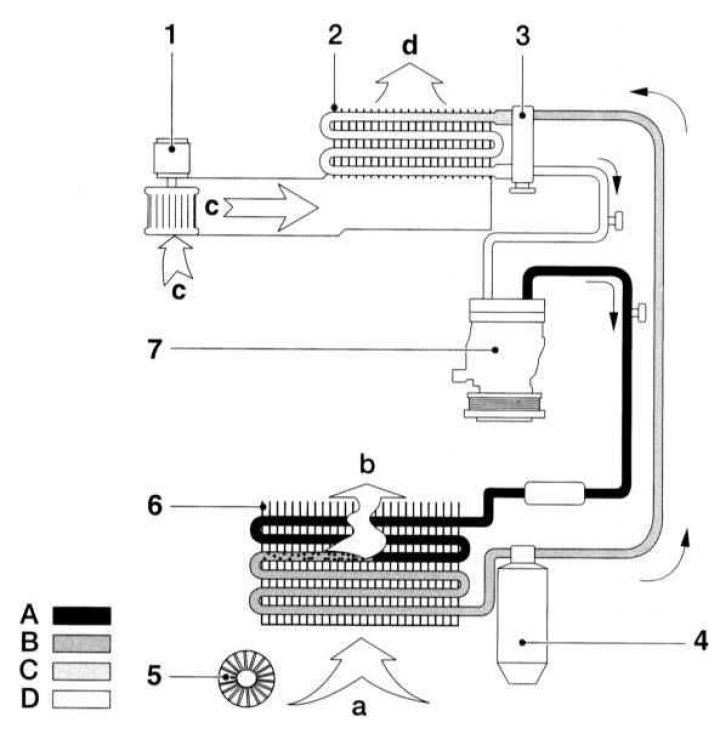
Air Conditioner Circuit Diagram
1 - Fan; 2 - Evaporator; 3 - Expansion valve; 4 - Reservoir; 5 - Condenser fan; 6 - Capacitor; 7 - Compressor; a - Outside air for cooling the condenser; b - Warm air exhausted to the outside; c - Uncooled air passing through the fan; d - Cooled air entering the cabin; A - High pressure, gaseous; B - High pressure, liquid; C - Low pressure, liquid; D - Low pressure, gaseous
The functional diagram of a typical air conditioning system is shown in the illustration. Work on the air conditioning system must be carried out by a specialized workshop. Never open the refrigerant circuit, since the refrigerant can cause frostbite if it comes into contact with the skin.
With the help of the air conditioning system, the temperature of the air in the cabin can be lowered below the outside temperature. When the system is operating, the humidity in the cabin decreases. In damp weather, the incoming fresh air is pre-cooled, after which it is heated again to the set temperature. This is how it is dried. This procedure removes fogging of the windows.
The air conditioning system consists of a compressor, condenser, throttle, evaporator, refrigerant tank and connecting pipelines.
The air conditioning system consists of a condenser located in front of the cooling system radiator, an evaporator located in a common casing with the heater heat exchanger, a compressor, a receiver/dryer, and refrigeration tubes connecting the above components. A damper is installed at the evaporator inlet, providing the pressure difference necessary for the system to function. The working fluid in the A/C system tract is refrigerant type R134a, which changes its state of aggregation depending on a combination of determining parameters (temperature and pressure).
The fan supplies cabin air to the evaporator, which operates on the principle opposite to the radiator, and the carburetor takes heat from the air and transfers it to the coolant. When heated, the coolant evaporates and turns into a gaseous state at the outlet of the evaporator.
The air conditioner compressor is driven by the engine crankshaft via a belt drive and provides excess pressure of up to 30 atm in the working tract of the system. As a result of adiabatic compression, the refrigerant, which is in a gaseous state, heats up. Entering the condenser, the refrigerant is cooled by the through flow of outside air and, condensing, turns into a liquid under high pressure. When passing through the throttle, the pressure of the liquid refrigerant is released. Then, the refrigerant evaporates in the circuit, simultaneously cooling strongly and, passing through the evaporator, takes heat from the air blown through it. The cooled air is supplied to the car interior. As a result of heating in the evaporator, the refrigerant turns into a low-pressure gas and again enters the compressor, after which the circulation process is repeated.
Safety precautions when servicing air conditioning system components
Warning! The system is under pressure! Do not attempt to disconnect any pipes related to the air conditioning system without first removing the working fluid from it. Removing fluid from the system is a fairly complex operation that should be performed at a service station. The system contains R134a refrigerant. Make sure that the station has the necessary equipment for this type of refrigerant. Use safety glasses when disconnecting system pipes.
The air conditioning system must be serviced only by trained technical personnel, trained in safe operating practices, using the proper equipment, observing the rules for depressurization, familiar with the methods of collecting and storing automotive refrigerant.
- The refrigerant R134a used today is much less aggressive than the previously used refrigerant type R12. However, it is very dangerous to health. Do not allow it to come into contact with your eyes or skin - you can get a burn. Although it is not toxic, its vapors can cause suffocation - do not remove it from the system in a closed room. Its vapors are heavier than air, so do not stand under the car when removing it from the system;
- Do not allow refrigerant vapors to come into contact with an open flame. When it burns, it produces toxic gas. The gas, mixed with air in a certain proportion, can become explosive. Inhaling vapors through a lit cigarette can lead to tragic consequences;
- Do not allow the refrigerant to enter the atmosphere. Unlike R12, the refrigerant type R134a does not cause destruction of the ozone layer, but leads to the greenhouse effect in the atmosphere;
- The system uses seals made of a special material designed to work with a given type of refrigerant (for 134a - green). In order not to accidentally mix different types of refrigerants, a certain type of adapter is used to fill a certain type of refrigerant;
- The system must be discharged at a Mercedes-Benz service station;
- Before carrying out any work related to heating any vehicle components (welding, soldering, drying after painting), discharge the system. It is also necessary to discharge the system before servicing any of the air conditioning system components;
- Wear safety glasses when working near the air conditioning system;
- If refrigerant gets on your skin or in your eyes, do not rub the affected area. Rinse immediately with cold water for at least 15 minutes. Seek immediate medical attention or medical attention. Self-medication is not allowed;
- The refrigerant in a new cylinder is stored under pressure. Store the cylinder at a temperature not exceeding 50°C. Take measures to prevent the cylinder from falling from a height or other situations that may cause damage to it;
- Work should be carried out in a well-ventilated area - the refrigerant is highly volatile and the accumulation of its vapors can lead to breathing difficulties;
- The gaseous refrigerant is heavier than air and should collect relatively quickly at a low level, such as under a car;
- Cleaning the condenser or evaporator with water vapor is not permitted - use only cold water or compressed air.
[Original material on the website: www.mercedesman.ru]