



Contents: Warning signals (seat belts) ↡ Fastening the seat belt ↡ Releasing the seat belt ↡ Operating principle ↡ Pelvic belt at the back ↡ Seat belt tensioners ↡
Many countries have laws that require seat belts to be worn. However, regardless of these laws, everyone in a car (both front and back) must always use seat belts.
This also applies to vehicles with seat belt tensioners and airbags (AIR-BAG), as these systems provide complete safety only when the vehicle occupants are wearing seat belts.
Warning! All seat belts are designed for one person only. They are not intended for persons (this is especially true for children) up to 140 cm tall. They are allowed to ride in a car only in the back seat with the use of a support system. The child safety devices we offer can be attached to existing seat belt devices. Information about them will be given to you at any service center "Mercedes Benz".
Warning signals (seat belts)
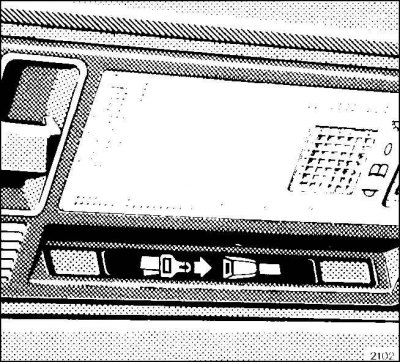
These signals remind you to fasten your seat belts before you start driving. After a short flash, they will automatically go out.
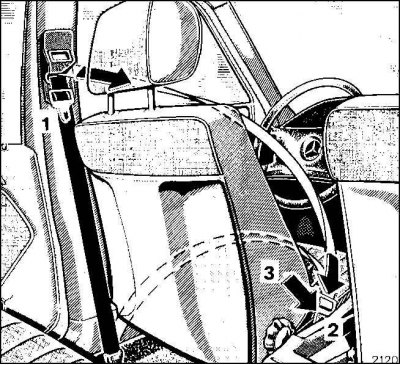
The car is equipped with seat belts on all seats, and on the front seats there are also belt tensioners with an automatic belt retractor system.
Fastening the seat belt
Material taken from a web resource (www.mercedesman.ru)
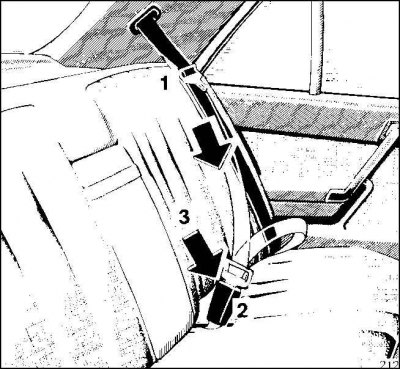
Pull the belt with the locking tongue (1) over the shoulder and pelvic area so that the pelvic part of the belt passes in front of the shin bones. For safety reasons, the belt must not be twisted or kinked. Avoid sitting positions that prevent the seat belts from being installed correctly.
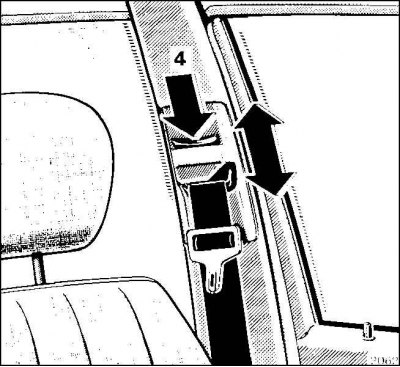
Insert the locking tongue (1) into the buckle (2) until you hear a click. Put the seat belts on the front seats so that the upper belt strap passes through the middle of the shoulder. For this purpose, the seat belt outlet can be adjusted in height by pressing the button (4) (3 positions).
The belt should fit tightly. It is necessary to control it when putting it on, as well as when driving. The pelvic part of the belt can be tightened by pulling the upper part of the belt up.
Releasing the seat belt
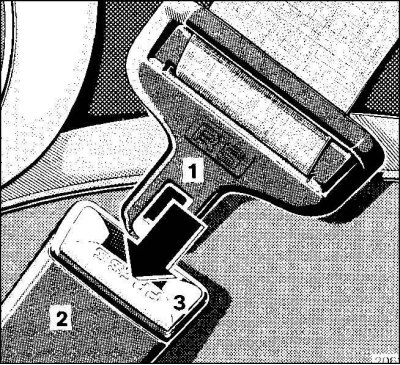
Press button (3) in lock (2). Pull out tongue (1). The seat belt buckles on the left and right rear seats can be "drowned" in the grooves of the seat cushions.
Operating principle
The automatic seat belt retractor prevents the belt from rolling out during fast driving and braking.
The automatic locking function can be controlled by quickly moving the belt tape.
Pelvic belt at the back
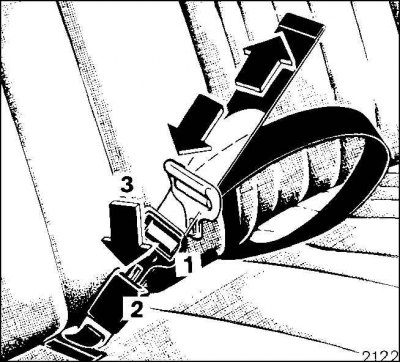
The belt with the locking tongue must cover the pelvic area in front of the shin bones. Insert the locking tongue (1) into the buckle (2) until it clicks. The belt must not be twisted and must fit tightly for safety reasons, avoid sitting positions that prevent the seat belts from being properly fastened.
To shorten the belt, pull the end of the belt with the lock snapped in. To lengthen the belt, set the locking tongue slightly more than 90° to the belt tape before putting the belt on and pull it out like that.
To loosen the belt, press button (3) in lock (2).
If the middle seat is not occupied, insert the buckle and the unfolded seat belt into the slots under the back of the rear seat (to the left and right of the armrest).
Seat belt tensioners
They are used with the automatic seat belt release system (with the key in positions 1 and 2 in the steering column lock).
Seat belt tensioners are designed to operate only in severe accidents. They tighten the seat belts so that they fit tightly to the body and ensure minimal forward movement of the body.
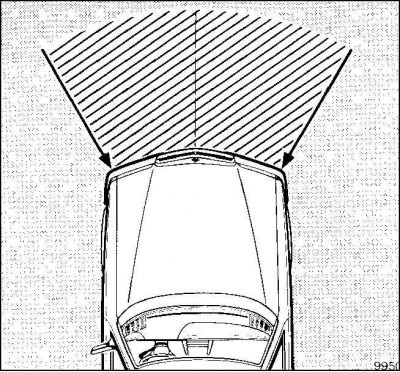
In minor frontal crashes, rollovers, side or rear impacts, or other crashes in which no strong forces are applied from the front, the seat belt pretensioners do not operate. The driver and all other passengers are protected by the usual seat belts.