
Cars BMW Cars Volkswagen Cars Chevrolet Cars Land Rover Cars Lada Cars Honda Cars Peugeot
English Русский
Български
Беларускі
Український
Српски
Hrvatski
Română
Polski
Slovenský
Magyar
Bookmark News and articles Sitemap Feedback Site search
MercedesMan.ru


A-Class C-Class E-Class G-Class M-Class S-Class Others
W163 (1997-2005)
  • Main
  • M-Class
  • W163 (1997-2005)
  • Transmission
  • Automatic gearbox
  • General principles of operation of the transmission system, control signals

General principles of operation of the transmission system, control signals (Mercedes-Benz M-Class W163)

0
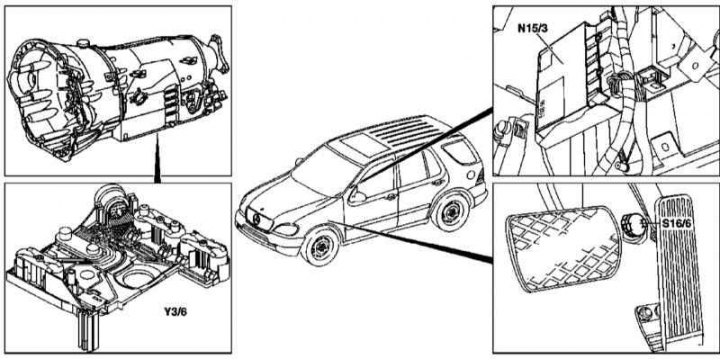
The diagram/design of the layout of the main components of the electronic transmission control system and the identification map of the terminals of the 13-pin AT connector are shown in the illustrations.

Layout diagram of the components of the electronic control system of the AT

Layout diagram of the components of the electronic control system of the AT
N15/3 - Transmission Control Module (TCM); S16/6 - Kickdown mode activation switch sensor; Y3/6 - Electrical unit of the electrohydraulic control unit for shifting
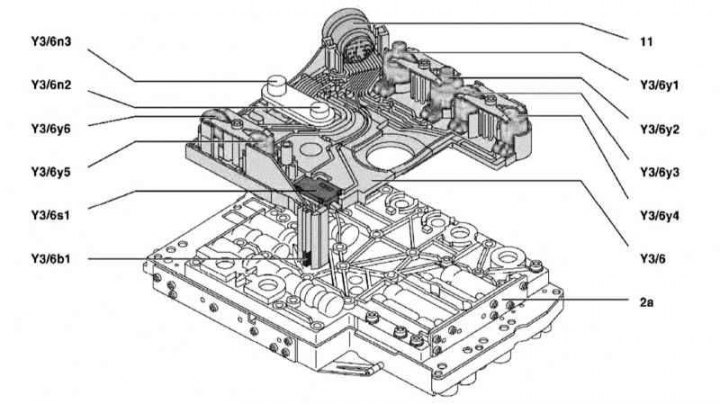

Design of the electro-hydraulic shift control unit

Design of the electro-hydraulic shift control unit
2a - Hydraulic block; 11 - 13-pin connector; Y3/6 - Electric Shift Control Unit; Y3/6b1 - ATF temperature sensor; Y3/6n2 - 2 rpm sensor; Y3/6n3 - 3 rpm sensor; Y3/6s3 - Start interlock contact; Y3/6y1 - Solenoid valve for pressure modulation control; Y3/6y2 - Solenoid valve for pressure control of switching; Y3/6y3 - Solenoid valve for switching 1-2 and 4-5; Y3/6y4 - Solenoid valve for switching control 3-4; Y3/6y5 - Solenoid valve for switching control 2-3; Y3/6y6 - Electromagnetic valve of the PWM lock-up of the torque converter
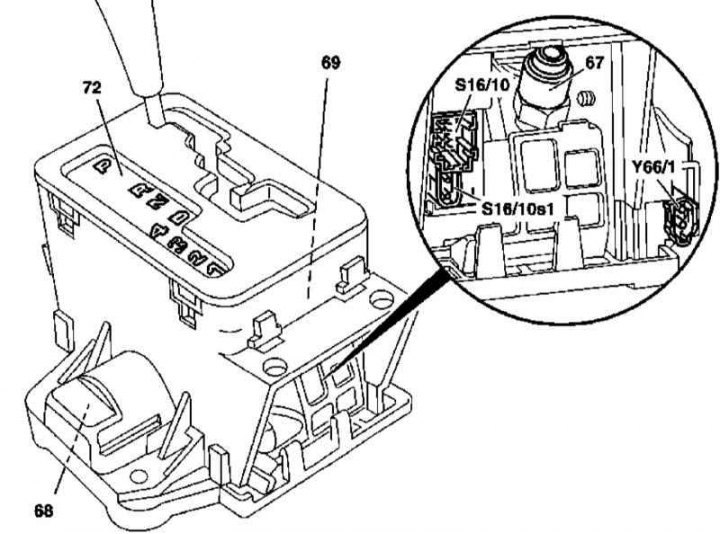


Design of the selector module (without the function of sequential range selection, - models…

Design of the selector module (without the function of sequential range selection, - models produced before 31.08.99)
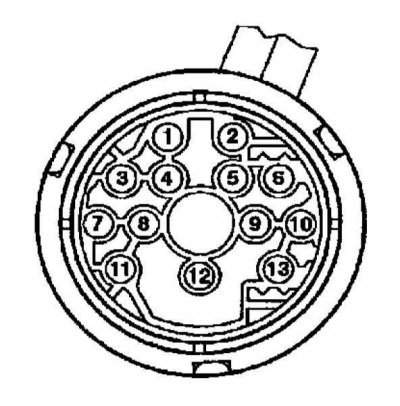

Electrohydraulic shift control unit 13-pin connector terminal identification map

Electrohydraulic shift control unit 13-pin connector terminal identification map
1 - 3 revolution sensor (Y3/6n3); 2 - Solenoid valve for modulating pressure regulation (Y3/6y1); 3 - 2 revolution sensor (Y3/6n2); 4 - Input signal of temperature sensor (Y3/6b1) and starter interlock contact (Y3/6s1); 6 - Supply voltage of electromagnetic valves; 7 - Sensor supply voltage; 8 - 2-3 shift solenoid valve (Y3/6y5); 9 - 3-4 shift solenoid valve (Y3/6y4); 10 - Solenoid valve for switching pressure regulation (Y3/6y2); 11 - Solenoid valve (rotation converter locks) (Y3/6y6); 12 - Sensor housing; 13 - 1-2/4-5 shift solenoid valve (Y3/6y3)


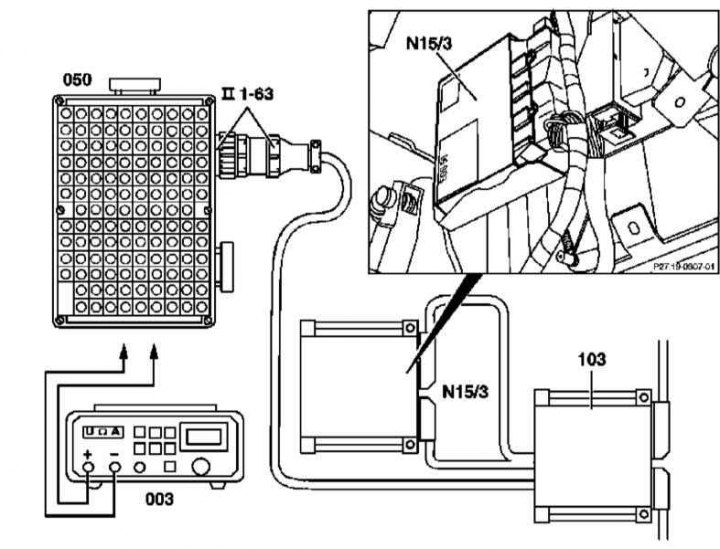
The TCM (N15/3) determines the current operating parameters of the vehicle and controls sequential gear shifting based on shift ease and driving parameters.

The electromagnetic switching valves are activated by a command from the ETC control unit (N15/3). The required pressure value is calculated based on the incoming data and the necessary adjustment is made to the transmitted torque.

Processed parameters


Illustrative material on the principle of data exchange in the AT control system is presented in the illustration.
Input and output signals of the AT 722.6 control unit and the CAN data bus

Input and output signals of the AT 722.6 control unit and the CAN data bus
N15/3 - TCM; X11/4 - DLC connector; Y3/6b1 - ATF temperature sensor; Y3/6n2 - Speed sensor 2; Y3/6n3 - Speed sensor 3; Y3/6s3 - Starter interlock contact; Y3 / 6y1-Solenoid valve for controlling pressure modulations; Y3 / 6Y2-E/M switching pressure control valve; Y3 / 6y3-E / M switching valve 1-2 and 4-5; Y3 / 6Y4-E / M switch valve 3-4; Y3 / 6y5-E / M switch valve 2-3; Y3 / 6Y6-E/M PWM torque converter lock valve; A1 - Instrument cluster; CAN - Engine Compartment Network Bus; N3/10 - ECM ME-SFI; N3/9 - ECM CDI; N15/3 - TCM; N15/5 - Electronic selector module; N47 - ETS Traction Control Module; N73 - Electronic Ignition Switch EIS Control Module


Control unit ME-SFI (N3/10)/CDI (N3/9)


  • Engine torque;
  • Gear shifting;
  • Emergency mode;
  • Tempostat functioning;
  • Activating the speed limiting system;
  • Starter operation;
  • Activating kickdown mode;
  • Engine operating parameters.

Electronic selector module (N15/5)


  • Selector lever position;
  • Transmission Mode Switch Sensor (S16/5);
  • Kickdown mode activation switch sensor (S16/6).

ETS control unit (N47)


  • Wheel speed;
  • Brake torque;
  • The fact of pressing the foot brake pedal;
  • Parking brake condition.

EIS control unit (N73)


  • Condition of contact terminals;
  • Transmission option.

Instrument cluster (A1)


  • Selector lever position/gear selected.

ETS control unit (N47)


  • Transmission option;
  • Information about the selected gear.

Control unit ME-SFI (N3/10)/CDI (N3/9)


Full article available on the resource: www.mercedesman.ru
  • Engine torque;
  • Emergency mode;
  • Activating the driving mode;
  • Selector lever position P/N;
  • Transmission Mode Switch Sensor (S16/5);
  • Transmission option.
This article is available at: russian, bulgarian, belarusian, ukrainian, serbian, croatian, romanian, polish, slovak, hungarian
The article has been verified: Panova Maya Vladimirovna
Share with friends:
◀ Previous
M-Class W163 / Automatic gearbox
Next ▶

Troubleshooting — General Information
Automatic transmission specifications
Adjusting the automatic transmission shift drive
Removal and installation the electro-hydraulic shift control unit
Removal and installation of AT with a torque converter
Removal and installation the selector module
Removal and installation the electronic ignition switch (EIS) interlock cable
More similar articles for repairing other models

☛ General description of the braking system Mercedes W168 (1997-2004)
☛ Using an Oscilloscope to Monitor Signals in Control System Circuits Mercedes W203 (2000-2007)
☛ Cooling system — general information Mercedes W123 (1976-1985)
☛ General principles of operation of the transmission control system,… Mercedes W463 (1999-2019)
☛ Using an Oscilloscope to Monitor Control System Signals Mercedes W140 (1991-1998)
☛ General description of the diesel fuel injection system Mercedes Sprinter (1995-2000, diesel)
Link in different formats to this article
Comments and feedback from visitors
No comments yet


How much will 46 + 24 ?


W163 (1997-2005) 
  • General information
  • Introduction to the guide
  • Controls and instruments
  • Driving and operation
  • Maintenance
  • Power unit
  • Gasoline engines
  • Diesel engines
  • Cooling system
  • Heating and ventilation
  • Power system (gasoline)
  • Fuel system (diesel)
  • Exhaust system
  • Ignition and control system
  • Charging and starting system
  • Transmission
  • Mechanical gearbox
  • Automatic gearbox
  • Clutch
  • Drive shafts and cardan
  • Transfer case
  • Chassis
  • Brake system
  • Front suspension
  • Rear suspension
  • Steering
  • Suspension geometry
  • Body
  • Exterior (external elements)
  • Interior (internal elements)
  • Doors and locks
  • Electrical equipment
  • Equipment and devices
  • Drive motors
  • Lighting and signaling
  • Audio system
  • Electrical circuits
 
MercedesMan.ru © 2017–2026 · Mobile version · Read about Mercedes · Sitemap: EN BG BY UA RS HR RO PL SK HU · Feedback · Site search · Bookmark A-Class (W168) · C-Class (W201) · C-Class (W202) · C-Class (W203) · E-Class (W123) · E-Class (W124) · E-Class (W210) · G-Class (W463) · M-Class (W163) · S-Class (W116, petrol) · S-Class (W126, petrol) · S-Class (W140) · S-Class (W220) · Sprinter · Vito 1 · Vito 2 · Vario 814D ·
 
We only use cookies without which some of the site's features may not be available.