
Cars BMW Cars Volkswagen Cars Chevrolet Cars Land Rover Cars Lada Cars Honda Cars Peugeot
English Русский
Български
Беларускі
Український
Српски
Hrvatski
Română
Polski
Slovenský
Magyar
Bookmark News and articles Sitemap Feedback Site search
MercedesMan.ru


A-Class C-Class E-Class G-Class M-Class S-Class Others
W463 (1999-2019)
  • Main
  • G-Class
  • W463 (1999-2019)
  • Power unit
  • Power system (gasoline)
  • Relieving pressure in the fuel system of a gasoline engine

Relieving pressure in the fuel system of a gasoline engine (Mercedes-Benz G-Class W463)

0
Note: Before you begin, read the safety precautions in Section General information and safety precautions.


Caution! After performing the procedure described below, you will only remove excess pressure from the fuel system. Gasoline will remain in the lines. Before disconnecting any fuel hose, take all necessary precautions!
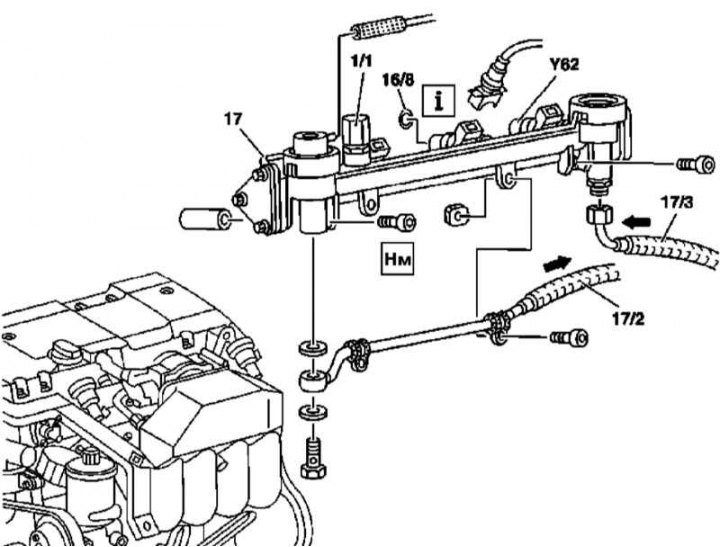

Location of the service valve (1/1) for relieving pressure on the fuel line of gasoline engines

Location of the service valve (1/1) for relieving pressure on the fuel line of gasoline engines
1/1 - Service valve; 1/4 - Screw; 2/1 - Resonator casing; 17 - Fuel line; 17/1 - Bolts; 17/2 - Fuel supply line; Y62 - Injectors


The main components of fuel systems of gasoline engines are the fuel tank, the fuel pump located inside it with a fuel level sensor, a fuel filter, injectors, a pressure regulator and a set of connecting lines.

When the engine is running, the fuel inside the fuel system path is under pressure, which continues to be maintained for a fairly long time after the ignition is turned off. Before disconnecting any of the system components, the pressure in the stroke must be released.

The simplest way to relieve pressure in the fuel system is to start the engine with the fuel pump fuse removed - wait until the engine stops on its own, then, to ensure complete pressure relief, turn it over several more times with the starter. If the engine fails to start, turn it over with the starter for several seconds. After completing the procedure, turn off the ignition and put the removed fuse back in place.


At service stations, the pressure in the fuel system is released through a service valve located on the fuel distribution line and operating on the principle of a simple nipple. Wrap the valve in a rag, remove the cap and press on the nipple - do not forget to return the cap to its place after completing the procedure.

Remember that after releasing the pressure/removing fuel from the fuel system, it takes a little longer than usual to start the engine - you will have to turn the crankshaft with the starter for several seconds until the pressure in the system is restored and the fuel fills all the fuel lines.
This article is available at: russian, bulgarian, belarusian, ukrainian, serbian, croatian, romanian, polish, slovak, hungarian
The article has been verified: Polyakov Zakhar Grigorievich
Share with friends:
◀ Previous
G-Class W463 / Power system (gasoline)
Next ▶

Checking and adjusting idle speed / ignition timing / CO concentration
General information and safety precautions
Power supply system specifications
The operating principle of the control and injection system of a gasoline engine
General check of the petrol engine injection system
Checking the injectors
Removal and installation air intake tract components
Maintenance of throttle actuator components
More similar articles for repairing other models

☛ Fuel System — Pressure Relief Mercedes W168 (1997-2004)
☛ Relieving pressure in the fuel system Mercedes W203 (2000-2007)
☛ Scheme 8. Diesel engine injection system with high-pressure fuel pump… Mercedes W210 (1996-2002)
☛ Relieving pressure in the fuel system of a gasoline engine Mercedes W163 (1997-2005)
☛ Relieving pressure in the fuel system of a gasoline engine Mercedes W140 (1991-1998)
☛ Diesel Engine Fuel System Specifications Mercedes Sprinter (1995-2000, diesel)
Link in different formats to this article
Comments and feedback from visitors
No comments yet


How much will 19 + 35 ?


W463 (1999-2019) 
  • General information
  • Introduction to the guide
  • Controls and instruments
  • Driving and operation
  • Maintenance
  • Power unit
  • Engine repair
  • Cooling system
  • Heating and ventilation
  • Power system (gasoline)
  • Fuel system (diesel)
  • Exhaust system
  • Ignition and control system
  • Charging and starting system
  • Transmission
  • Automatic gearbox
  • Transfer case
  • Axles front and rear
  • Chassis
  • Brake system
  • Front suspension
  • Rear suspension
  • Steering
  • Body
  • Exterior (external elements)
  • Interior (internal elements)
  • Doors, locks and windows
  • Electrical equipment
  • Equipment and devices
  • Switches in salon
  • Headlights and lighting
  • Audio system and navigation
  • Electrical circuits
 
MercedesMan.ru © 2017–2026 · Mobile version · Read about Mercedes · Sitemap: EN BG BY UA RS HR RO PL SK HU · Feedback · Site search · Bookmark A-Class (W168) · C-Class (W201) · C-Class (W202) · C-Class (W203) · E-Class (W123) · E-Class (W124) · E-Class (W210) · G-Class (W463) · M-Class (W163) · S-Class (W116, petrol) · S-Class (W126, petrol) · S-Class (W140) · S-Class (W220) · Sprinter · Vito 1 · Vito 2 · Vario 814D ·
 
We only use cookies without which some of the site's features may not be available.