



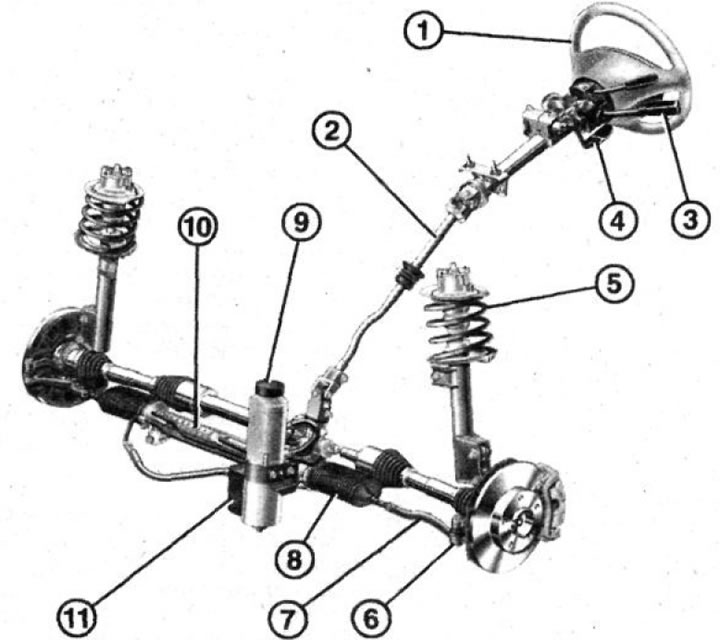
14.0 Steering Parts
1 - steering wheel
2 - steering shaft
3 - switch on the steering column (steering column switch)
4 - steering wheel height adjustment lever
5 - shock absorber strut
6 - tie rod end
7 - ball joint of the tip
8 - steering gear cuff
9 - Power steering fluid reservoir
10 - rack and pinion steering mechanism
11 - Power steering pump
The steering system consists of a steering wheel, a steering column, a rack and pinion mechanism and tie rods (see illustration 14.0).
The steering column transmits the movement of the steering wheel to the steering rack, which moves according to the turn of the steering wheel, to the right or left.
The tie rods transmit the steering forces of the vehicle through the ends and steering knuckles to the wheels.
The rack and pinion steering is easy to operate and has no play. The steering mechanism is maintenance-free, eliminating the need to check the condition of the cuffs and the dust caps of the steering rod ends.
Hydraulic power steering (servo control) ensures that minimal effort is applied when turning the wheels. The hydraulic booster consists of an oil pump, a fluid tank and pressure lines.
The oil pump is driven by a V-belt. The pump sucks hydraulic oil from the receiver and drives it under high pressure to the valve stem.
The valve stem is mechanically connected to the steering column and directs oil, depending on the direction of rotation of the steering wheel, to the corresponding part of the working cylinder in the steering gear housing. There, the oil presses on the piston of the toothed rack and thus supports the driver's effort applied to the steering wheel. At the same time, the piston on the other side of the working cylinder squeezes hydraulic fluid into the reservoir through the return hose.
Attention! Welding and straightening work on steering components is prohibited. When carrying out repair work, always replace self-locking nuts, as well as rusted bolts and nuts with new ones.
Attention! The tightening torques of threaded connections specified in this chapter must be observed. If the car owner does not have sufficient experience in performing repair work on the car, it is recommended to entrust them to a workshop.
The steering wheel is fitted with an inflatable driver's airbag, which is a folded bag that instantly fills with air during a frontal collision, thereby protecting the driver's torso and head from impact with the steering wheel.
If the impact is strong enough, the control unit ignites a small explosive charge and the gases produced by the explosion fill the airbag within a few milliseconds. This is enough time to soften the impact with the steering wheel. Then, within a few seconds, the airbag collapses as the gases are released through the outlet holes.