



At the moment when the piston of the cylinder almost reaches the top dead center, diesel fuel is injected into the air, compressed and heated to approximately +600°C. The fuel ignites spontaneously, so spark plugs are not needed.
When the engine is very cold, the ignition temperature is not reached by compression alone. In this case, the engine must be preheated. For this purpose, each cylinder has a glow plug in the combustion chamber, which heats the combustion chamber.
The warm-up duration depends on the ambient temperature and is regulated by the engine control unit via the warm-up relay.
Fuel is sucked in by the fuel supply pump directly from the fuel tank and pumped to the high-pressure fuel pump at a pressure of approximately 3.5 bar.
Even at low engine speeds, the high-pressure fuel pump creates a constant pressure of just over 1,300 bar.
The high-pressure fuel pump is connected to a main fuel distribution line with fuel injectors for each cylinder (see illustration 1.0).
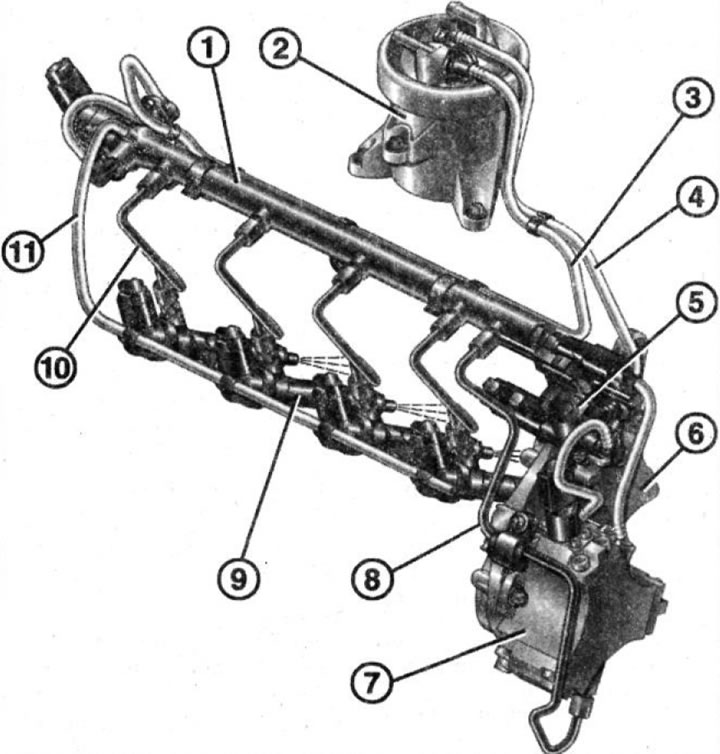
1.0 Distribution rail of a diesel engine with direct fuel injection (CDI)
1 - distribution main
2 - fuel filter
3 - return fuel line
4 - fuel supply line to the high-pressure fuel pump
5 - fuel cut-off electromagnetic valve
6 - fuel supply pump
7 - Fuel injection pump (high pressure fuel pump)
8 - fuel injection line (to the distribution main)
9 - nozzle
10 - fuel injection line (to the nozzle)
11 - return fuel line)
The main fuel line is a kind of fuel and high-pressure accumulator that distributes the incoming fuel between the injectors with constant pressure.
Electromagnetic fuel injectors inject fuel into their cylinders. However, the amount of fuel injected is determined and set by the engine control unit. If, for example, the control unit closes the injectors, then fuel injection stops.
In other words, fuel injection and pumping are performed independently of each other.
The advantage is that the amount of fuel injected is dependent on the current operating load on the engine, which also optimises the content of harmful substances in the exhaust gases.
However, the amount of injected fuel does not depend on the engine speed.
Through a multi-jet nozzle, fuel is injected in two stages.
At first, a small, preliminary amount of fuel is injected, which improves the conditions for ignition of the main portion of fuel. This leads to a softer and at the same time quieter combustion of the mixture.
Before getting to the fuel injection pump and the high-pressure fuel pump, the fuel passes through the fuel filter, where contaminants and water are retained. Therefore, it is extremely important to replace the fuel filter in due time, as required by the maintenance conditions.
The fuel supply pump and the high-pressure fuel pump do not require maintenance. All moving parts of the pump are lubricated with diesel fuel.
Air for the formation of the fuel-air mixture is taken in by the engine or forced by the turbocharger through the air filter.
The turbocharger compresses air and delivers it to the engine through the charge air cooler radiator (intercooler). The intercooler cools the hot boost air. This improves cylinder filling, which in turn leads to increased torque and engine power.
Operation of a diesel engine in winter conditions
As the temperature decreases, the fluidity of diesel fuel decreases, it thickens and becomes paraffinized.
Diesel fuel can become viscous, and its fluidity in this state can be compared to the viscosity of honey.
As a result of thickening, the fuel filter becomes clogged. For this reason, diesel fuel manufacturers add additives to diesel fuel in winter, which allow maintaining the required fluidity and ensuring engine start at temperatures down to -22°C.
To prevent the fuel filter from becoming clogged in the cold season, hot fuel (return) from the high-pressure fuel pump is diverted to the filter through the fuel heating valve.
Fuel injection in diesel engines is completely controlled by the control unit. This provides the following advantages:
- a) engine self-diagnosis, which allows you to quickly detect a malfunction;
- b) precise dosing of injected fuel. This ensures a reduction in the content of harmful substances in the exhaust gases and reduces fuel consumption;
- c) there is no need to regulate the idle speed, as well as the set speed at which the regulator begins to limit the fuel supply.
All engine management system components are designed for long service life and require virtually no repairs.
As part of the maintenance, it is only necessary to change the replaceable filter element of the air filter and the fuel filter.
(Article based on data from the website: mercedesman.ru)
Diesel engine preheating device
If the engine is cold, the air temperature formed during its compression is not sufficient for the self-ignition of the injected fuel. In this case, the engine needs to be preheated.
For this purpose, a glow plug is installed in the combustion chamber of each cylinder. The glow plug is a housing with a pressed glow pin.
The glow pin has a glow coil and a current regulation winding.
When voltage is applied, the coil inside the pin heats up to a temperature of over +850°C within a few seconds.
At the same time, a current of approximately 30 Amperes passes through the pin of each spark plug.
As the temperature in the chamber increases, the resistance of the control winding increases, reducing the current to 15 - 25 Amperes. This protects the glow plug from overheating.
As soon as the preheating indicator light on the instrument panel goes out, the engine can be started.
The duration of the engine preheating rarely exceeds 10 seconds and is regulated by the engine control unit, which requests data on the current engine temperature from the coolant temperature sensor.
Based on the received data, the control unit determines the heating duration and the glow plug current.
Caution! The diesel engine has good cold starting capability. Therefore, preheating is only necessary at air temperatures below 0°C.